
Your cumulative GPA combines all coursework that your school includes in its GPA calculation.
The basic formula is:
Cumulative GPA = Total Quality Points ÷ Total GPA Credits
Do not average your semester GPAs unless the semesters have the same number of GPA-counted credits. Your school also decides which grades, retakes, transfer courses, and special grading options count. The GPA on your official school record is the final reference. Texas A&M and Ohio State both use the total quality points divided by total applicable credit hours approach.
Quick answer: Add the grade points from all counted semesters, add the credits behind those points, and divide the two totals.
Calculate Your Cumulative GPA
Use the Cumulative GPA Calculator when you want to combine multiple semesters or check the effect of a new term.
For the most accurate result, use the quality points and GPA credits shown on your transcript when they are available.
Note: An online calculation is an estimate unless it matches your school’s exact GPA rules. Your official transcript remains the controlling record.
What is Cumulative GPA?
A semester GPA covers one term.
A cumulative GPA combines all GPA-counted coursework across the academic record being measured.
Cumulative GPA vs. related terms
You may also see:
Term or semester GPA: The GPA for one academic term.
Major GPA: The GPA calculated from courses included in a major or program.
Year GPA: A GPA covering an academic year. Some schools use separate calculations for different purposes.
Undergraduate and graduate GPA: These may be maintained separately. The University of Arizona, for example, calculates cumulative GPA by academic career level, so undergraduate and graduate coursework are not automatically combined.
The label “overall GPA” can mean the same thing as cumulative GPA at some schools, but terminology is not standardized. Use the definition provided by your school.
Where the numbers come from on a transcript
Your transcript may show several credit totals.
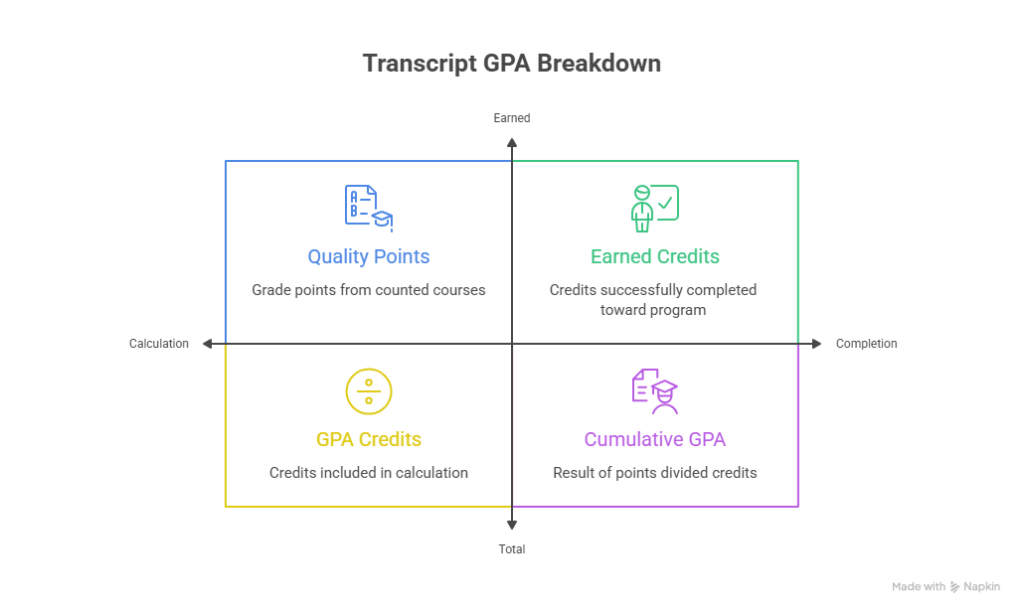
- GPA or attempted credits: The credits used in the school’s GPA calculation.
- Earned or passed credits: Credits you successfully completed toward your program.
- Quality points or grade points: The points produced by your letter grades and credits.
These numbers do not always match.
For example, Texas A&M excludes an S grade from its GPA calculation even though the student still earns the credit hour. That is why the school’s GPA hours and passed hours can differ.
When your transcript provides total quality points and GPA-counted hours, those are usually the most useful numbers for rebuilding the cumulative GPA.
How to Calculate Cumulative GPA Step by Step
Step 1: Convert each grade to grade points
Use your school’s grading scale.
Here is a common 4.0 plus/minus example:
| Letter Grade | Grade Points |
|---|---|
| A+ | Varies by school |
| A | 4.0 |
| A- | 3.7 |
| B+ | 3.3 |
| B | 3.0 |
| B- | 2.7 |
| C+ | 2.3 |
| C | 2.0 |
| C- | 1.7 |
| D+ | 1.3 |
| D | 1.0 |
| D- | 0.7 |
| F | 0.0 |
This table is an example, not a national GPA standard. Ohio State’s published calculation guide uses the same 4.0 values through D and includes D+ at 1.3.
An A+ deserves special attention because some schools assign it 4.0, while others use a different value. Check your school’s grading policy.
For help interpreting grade-point values, the GPA Scale provides a broader reference.
Step 2: Multiply grade points by credits
This gives you quality points.
For example:
A- = 3.7
In a 3-credit course:
3.7 × 3 = 11.1 quality points
This is the same basic calculation used by the University of Arizona and Ohio State.
Step 3: Add the quality points and credits
Add the quality points for all GPA-counted courses.
Then add the credits used in those calculations.
Step 4: Divide
Use:
Cumulative GPA = Total Quality Points ÷ Total GPA Credits
That gives your cumulative GPA before the final rounding step.
Worked Example: Four Semesters
Suppose a student’s semester records look like this:
| Semester | GPA Credits | Semester GPA | Quality Points |
|---|---|---|---|
| 1 | 15 | 3.40 | 51.0 |
| 2 | 12 | 2.90 | 34.8 |
| 3 | 16 | 3.60 | 57.6 |
| 4 | 14 | 3.10 | 43.4 |
| Total | 57 | 186.8 |
Now divide:
186.8 ÷ 57 = 3.2772
Rounded to two decimals:
Cumulative GPA = 3.28
This works because each semester’s GPA has first been converted back into quality points using the credits behind it.
A course-level example
You can also build a semester from individual courses.
| ourse | Credits | Grade | Grade Points | Quality Points |
|---|---|---|---|---|
| Biology | 4 | A- | 3.7 | 14.8 |
| History | 3 | B+ | 3.3 | 9.9 |
| English | 3 | B | 3.0 | 9.0 |
| Mathematics | 4 | A | 4.0 | 16.0 |
| Total | 14 | 49.7 |
Then:
49.7 ÷ 14 = 3.55
So the semester GPA is:
3.55
The same course-level method can be used across every semester to rebuild a cumulative GPA.
Why You Can’t Just Average Semester GPAs
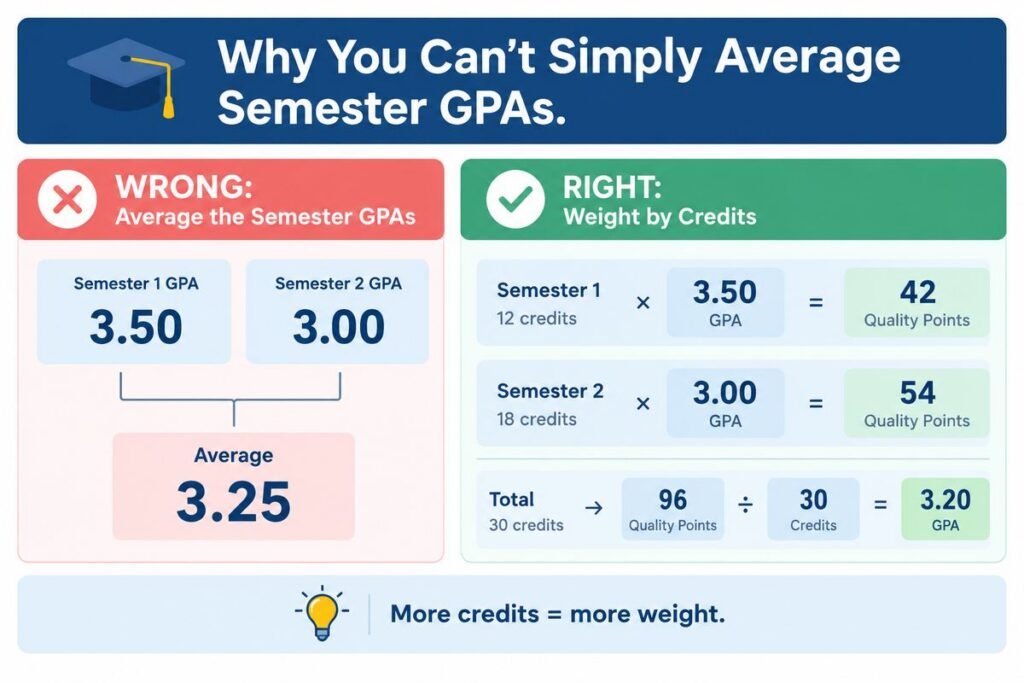
Suppose you have:
- Semester 1: 12 credits at 3.50
- Semester 2: 18 credits at 3.00
A simple average gives:
(3.50 + 3.00) ÷ 2 = 3.25
But the correct cumulative calculation is:
(12 × 3.50 + 18 × 3.00) ÷ 30
= (42 + 54) ÷ 30
= 3.20
The second semester has more credits, so it has more influence on the result.
Texas A&M makes the same point in its cumulative GPA guidance: do not add semester GPAs and divide by the number of terms.
When does averaging semester GPAs work?
A simple average works when the semesters have equal GPA credits.
For example:
- 15 credits at 3.20
- 15 credits at 3.60
Then:
(3.20 + 3.60) ÷ 2 = 3.40
The credit-weighted calculation produces the same result because both semesters have equal weight.
The rounding trap
Rounding can create a small difference when you rebuild a cumulative GPA from displayed semester GPAs.
Imagine:
- Semester 1: 18 credits and 44.6 quality points
- Semester 2: 9 credits and 33.0 quality points
The exact cumulative calculation is:
(44.6 + 33.0) ÷ 27 = 2.8741
Rounded:
2.87
But if the semester GPAs had already been rounded to:
- 44.6 ÷ 18 = 2.48
- 33.0 ÷ 9 = 3.67
and you use those rounded numbers:
(2.48 × 18 + 3.67 × 9) ÷ 27 = 2.8770
Rounded:
2.88
That is why using exact quality points is better when your transcript provides them.
How to Add a New Semester to Your Current GPA
If you already know your current GPA and the credits behind it, you can update the number without rebuilding every course.
Use:
New Cumulative GPA = [(Previous GPA × Previous GPA Credits) + New Quality Points] ÷ (Previous GPA Credits + New Credits)
Example
Suppose your previous record contains:
- 57 GPA credits
- 186.8 quality points
- Displayed cumulative GPA: 3.28
Your new semester has:
- 14 credits
- 47.0 quality points
Using the exact previous points:
(186.8 + 47.0) ÷ (57 + 14)
= 233.8 ÷ 71
= 3.2930
New cumulative GPA = 3.29
Now suppose you enter the rounded 3.28 instead of the exact 186.8 points:
(3.28 × 57 + 47.0) ÷ 71
= 3.2952
Under a two-decimal, half-up display rule, that becomes:
3.30
The difference comes from using a rounded GPA instead of the underlying quality points.
Best practice: If your transcript gives total quality points and GPA credits, use those values instead of rebuilding the calculation from rounded term GPAs.
What Can Change the Result?
The formula itself is simple. What counts in the formula is where schools differ.
| Situation | What can vary | What to check |
|---|---|---|
| Retakes | Replacement, highest-grade treatment, or multiple attempts may count | Registrar’s repeat policy |
| Pass/Fail and special grades | Some grades may be excluded from GPA | Grade legend and grading policy |
| Withdrawals | A W may be excluded from GPA, but treatment varies | Exact grade code |
| Transfer courses | Transfer grades may or may not enter the institutional GPA | Transfer-credit policy |
| Semester vs. quarter | Credit and quality-point totals must use the same basis | Receiving school’s instructions |
| Weighted high-school GPA | Advanced-course bonus points can be school-specific | High-school grading scale |
For example, the University of Arizona does not include transfer-course grades or Pass/Fail coursework in its institutional GPA. Texas A&M excludes several special grade codes, including S and W, from its GPA calculation. These are institutional examples, not national rules.
Retake example
Suppose a student has:
- 60 GPA credits
- 3.10 cumulative GPA
- 186 quality points
The student repeats a 3-credit course in which the original grade was F and earns a B worth 3.0 points.
If the school replaces the old grade
The original 3-credit course is already part of the 60 credits.
The new grade contributes:
3 × 3.0 = 9 quality points
So:
(186 + 9) ÷ 60 = 3.25
The denominator stays at 60 because the repeated course replaces the previous attempt rather than adding another three GPA credits.
If both attempts count
Then the second attempt adds three more GPA credits:
(186 + 9) ÷ 63 = 3.0952
So the result is about:
3.10
The policy makes the difference.
The University of Cincinnati, for example, allows eligible undergraduate students to request grade replacement so only the approved replacement grade is included in the cumulative GPA. The original and repeated courses still appear on the transcript.
High school GPA
High schools often use a different credit structure from colleges.
A 0.5-credit-per-semester course is one common setup, but the actual system is local. Your school’s grading scale determines how much each course contributes.
For example, six equal-weight courses with:
A, A, B+, B, A-, B
using the sample 4.0 scale produce:
(4.0 + 4.0 + 3.3 + 3.0 + 3.7 + 3.0) ÷ 6 = 3.50
If the same grades are attached to equal 0.5 credits, the GPA remains 3.50 because every course has the same weight.
Weighted high-school systems are different. Some schools add bonus points for advanced courses, but there is no single bonus scale that applies everywhere.
For high-school-specific calculations, see the High School GPA Calculator and 7 Steps to Calculate High School GPA.
Semester and quarter credits
You must put the credits and quality points on the same basis before combining them.
Ohio State’s Graduate School guidance gives this example:
- To convert quarter to semester, divide the institution’s quality points and credit hours by 1.5.
- To convert semester to quarter, multiply both by 1.5.
That is Ohio State’s stated method for its graduate admissions calculation, so do not assume another school will use the same procedure without checking.
Why Your GPA May Not Match Your Transcript
A mismatch does not automatically mean your arithmetic is wrong.
Check these items:
- Rounded term GPAs — Your school may calculate from more precise values.
- Excluded grades — W, Pass/Fail, and other special codes may be outside the GPA calculation.
- Retakes — The school may replace one grade, count both attempts, or use another rule.
- Transfer credits — Transfer coursework may count toward your degree without entering the institutional GPA.
- Weighted vs. unweighted scale — This matters especially in high school.
- Decimal places — Your school may retain more precision than it displays.
- Academic level — Undergraduate and graduate GPAs may be separate.
- Projected GPA — A student portal may show a projected or rolling figure rather than the final transcript calculation.
The University of Arizona is one example of a school that separates undergraduate and graduate GPA calculations and excludes transfer grades from its institutional GPA.
A quick transcript check
Look for these fields or labels:
GPA
GPA hours / attempted hours
Quality points / grade points
Earned or passed hours
If the transcript lists both quality points and GPA hours, divide those numbers first.
For example:
198.60 quality points ÷ 55.00 GPA hours = 3.61 GPA
If your own result differs, then look at retakes, excluded grades, transfer work, or rounding before assuming the formula is wrong.
What GPA Do You Need Next Semester?
You can work backward from a target GPA.
Use:
Required New GPA = [(Target GPA × Future Total Credits) − Current Quality Points] ÷ New Credits
Example
Suppose you have:
- 45 credits
- 3.20 cumulative GPA
- 144 quality points
- 15 upcoming credits
Target: 3.30
You need:
3.30 × 60 = 198 total quality points
You already have:
144
So you need:
198 − 144 = 54
Required next-semester GPA:
54 ÷ 15 = 3.60
You need a:
3.60 semester GPA
Target: 3.50
You would need:
3.50 × 60 = 210
Then:
210 − 144 = 66
66 ÷ 15 = 4.40
That is above a standard 4.0 ceiling.
The highest possible result after earning a 4.0 across all 15 credits would be:
(144 + 60) ÷ 60 = 3.40
So a 3.50 cumulative GPA is not mathematically reachable in that one semester under this example.
For a personalized target, use the Target GPA Calculator.
Why cumulative GPA moves slowly
As you accumulate more credits, one new semester has less influence on the overall average.
For example, 15 new credits are:
25% of a 60-credit record
but only about:
14% of a 105-credit record
That is why raising a cumulative GPA usually takes several strong semesters after a long academic record has been established.
A good semester can also lower your cumulative GPA if its GPA is below your current cumulative number.
For example:
60 credits at 3.50 + 15 credits at 3.40 = 3.48 cumulative GPA
For parents and teachers
When helping someone check a cumulative GPA, start with the official transcript and its definitions. Identify the GPA hours and quality points before doing the math. If the numbers still do not match, check the school’s rules for retakes, excluded grades, and transfer coursework.
Frequently Asked Questions
Is cumulative GPA the same as overall GPA?
Not necessarily. Some schools use the terms interchangeably, while others use separate calculations for academic level, major, or program. Check your school’s transcript or registrar policy for the exact definition.
Can I average my semester GPAs?
Yes, but only when the semesters have the same number of GPA credits. With different credit loads, calculate total quality points divided by total GPA credits instead.
How do I add a new semester to my GPA?
Use your previous quality points and GPA credits, then add the new semester’s quality points and credits. This is more accurate than using a rounded cumulative GPA.
Do retakes replace the old grade?
It depends on the institution. Some schools allow formal grade replacement, while others count both attempts or apply other rules. The University of Cincinnati, for example, uses a formal grade-replacement process for eligible undergraduate courses.
Do withdrawals or Pass/Fail grades count?
Not always. Texas A&M excludes W and several other special grades from its GPA, while the University of Arizona excludes Pass/Fail coursework from its institutional GPA. The exact treatment is school-specific.
Do transfer credits count toward GPA?
They may count toward your degree without counting toward your institutional GPA. The University of Arizona, for example, does not include transfer-course grades in its GPA.
How do I combine quarter and semester credits?
First put both records on the same credit basis. Ohio State’s graduate admissions guidance divides quarter quality points and credits by 1.5 to convert them to semester terms, and multiplies semester values by 1.5 to express them in quarter terms.
Why is my GPA different from my transcript?
Start with rounded term GPAs, excluded grades, retake treatment, transfer coursework, weighted scales, decimal precision, and separate academic-level GPAs. One of these usually explains the difference.
Can my cumulative GPA go down after a good semester?
Yes. If your new semester GPA is below your current cumulative GPA, the cumulative number can fall. A 3.40 semester, for example, lowers a 3.50 cumulative GPA slightly.
How many decimal places should I use?
Keep as much precision as your source data allows and round the final result. If your school displays three decimals, use three. Do not round each semester too early when you are rebuilding a cumulative GPA.
Sources and Policy Examples
The calculation and policy points above are based on the following university sources, reviewed September 30, 2026:
- How to Calculate GPA (Texas A&M University): cumulative GPA uses total grade points divided by attempted hours, with specific exclusions for certain grade codes.
- Grades and GPA Calculation (University of Arizona): explains term vs. cumulative GPA, career-level GPAs, transfer-credit treatment, special grades, and repeat-course rules.
- Calculate GPA (The Ohio State University): provides the quality-point method and semester/quarter conversion instructions.
- Grade Replacement (University of Cincinnati): provides a current example of a formal undergraduate grade-replacement policy and its effect on cumulative GPA.
These policies are institution-specific examples, not a single national GPA standard.
For related GPA calculations, readers can continue with the Cumulative GPA Calculator, GPA Scale, GPA to Letter Grade Converter, High School GPA Calculator and Target GPA Calculator.
For deeper guidance, see:
- 7 Steps to Calculate High School GPA
- GPA to Letter Grade Chart: The Complete Conversion Guide
- How GPA Works in High School: The Complete Guide
- What Is a Good GPA? A Grade-by-Grade Breakdown
- GPA Scale

Olivia Grant is a former K–12 teacher (12 years) and Lead Content Strategist at EasyGraderHub, holding an M.Ed. in Curriculum & Instruction from the University of Washington. She writes EasyGraderHub’s grading guides and reviews its calculators for classroom accuracy. Read more about Olivia.