
A 3.7 GPA is an A-. A 90% is an A-. A “B” on a plus/minus scale could mean a 3.0, or it could mean anything from a 2.7 to a 3.3, depending on your school. That range is where most of the confusion starts.
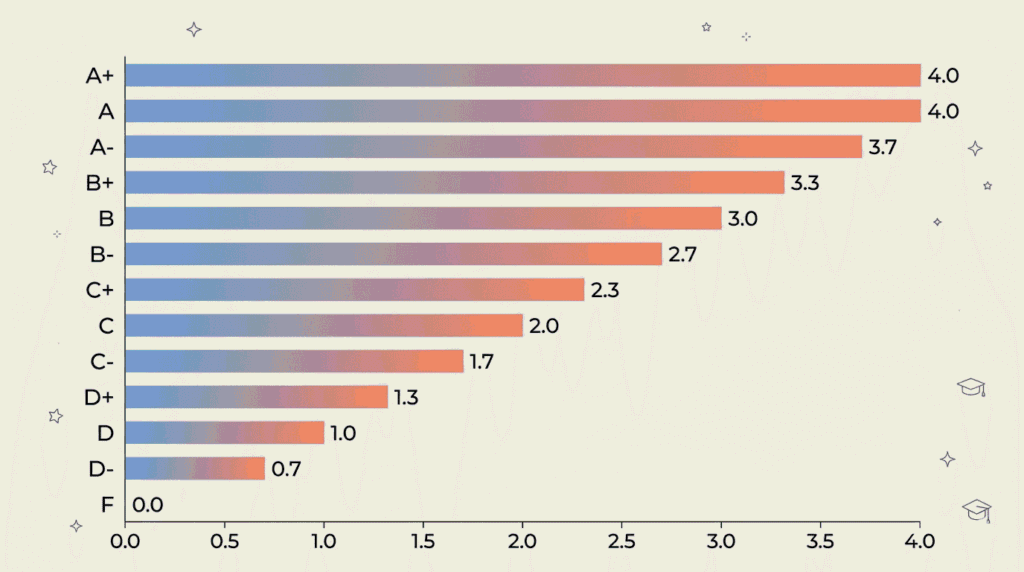
This chart clears it up in one place. Below, you’ll find the full 4.0-scale conversion grid, plus quick answers for the specific grades and percentages people search for most: what GPA is an A-, what GPA is a 90, what counts as “all B’s,” and how plus/minus scales differ from whole-letter ones.
I taught middle and high school for over a decade before I started building grading tools full time. Every fall, without fail, a parent or student would ask me to explain their report card in plain numbers. This chart is the answer I wish I’d had printed out and handed over every single time.
What GPA Is an A, A-, B+, B, B-, C+, or C?
Here’s the direct answer, using the standard U.S. plus/minus scale:
- A = 4.0 GPA (93–100%)
- A- = 3.7 GPA (90–92%)
- B+ = 3.3 GPA (87–89%)
- B = 3.0 GPA (83–86%)
- B- = 2.7 GPA (80–82%)
- C+ = 2.3 GPA (77–79%)
- C = 2.0 GPA (73–76%)
If your school reports “all B’s” without pluses or minuses, that averages out to a straight 3.0 GPA. But if even one of those B’s carries a plus or minus, the number shifts. A single B+ pulls the average up to roughly 3.06; a single B- pulls it down to roughly 2.94. Small letters, real math.
What GPA Is a 90? A 93? An 85?
Percentage-to-letter questions come up constantly, especially when a report card only shows a number grade. Here’s the crossover, matched to the chart above:
- 90% = A- = 3.7 GPA
- 93% = A = 4.0 GPA
- 85% = B = 3.0 GPA
Note the jump between 89% and 90%. That single point is the line between a B+ (3.3) and an A- (3.7), a 0.4 GPA swing. It’s the most common “why did my GPA drop” question I got as a teacher, and it usually traced back to exactly one missed point on one assignment.
The Full 4.0-Scale Conversion Grid
This is the master reference. Bookmark it, because it covers every letter grade and every percentage band on the standard U.S. scale.
| Letter Grade | Percentage | 4.0 GPA Scale |
|---|---|---|
| A+ | 97–100% | 4.0 |
| A | 93–96% | 4.0 |
| A- | 90–92% | 3.7 |
| B+ | 87–89% | 3.3 |
| B | 83–86% | 3.0 |
| B- | 80–82% | 2.7 |
| C+ | 77–79% | 2.3 |
| C | 73–76% | 2.0 |
| C- | 70–72% | 1.7 |
| D+ | 67–69% | 1.3 |
| D | 63–66% | 1.0 |
| D- | 60–62% | 0.7 |
| F | Below 60% | 0.0 |
A few things worth knowing about this table before you use it:
Some schools cap A+ at 4.0 instead of awarding above a 4.0, which is why the grid above treats A+ and A as equal on the standard unweighted scale. Weighted scales (Honors, AP, IB) add extra points on top of this base and follow a separate conversion.
If you’d rather skip manual lookups altogether, plug your grades straight into the GPA to Letter Grade Converter and get the exact number instantly.
Plus/Minus Grading vs. Whole-Letter Grading
Not every school uses the plus/minus scale above. Some still run on whole letters only: A, B, C, D, F, with nothing in between. The difference matters more than it looks.
Whole-letter systems are simpler but less precise. A 92% and an 80% both land in the “B” range under some whole-letter policies, even though they’re 12 points apart. Every B, regardless of where it falls in that 80-89 window, converts to the exact same 3.0 GPA.
Plus/minus systems split each letter into three tiers (B-, B, B+), so a 92% and an 80% land in different GPA bands, 3.3 versus 2.7 in some cases. This gives a more accurate picture of performance but also means a single point can shift your GPA more sharply, like the 89-to-90 example above.
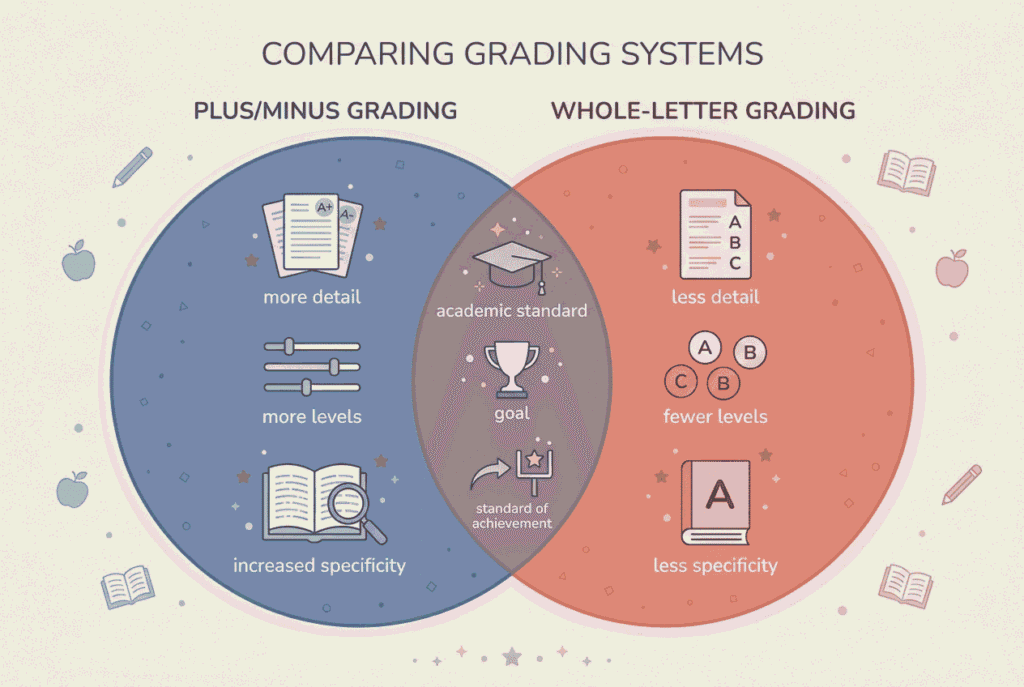
Neither system is universally “better.” Plus/minus rewards precision but adds volatility near the cutoffs. Whole-letter is more forgiving near cutoffs but flattens real differences in performance. Your school’s registrar or handbook will state which one applies to your transcript, and that’s the version you should always calculate against, not a generic scale.
Common Mistakes When Reading a GPA Chart
Using the wrong scale for weighted classes. An A in a regular class and an A in an AP class often convert to different GPA values on a weighted transcript. This chart reflects the unweighted, standard scale only.
Assuming every school’s cutoffs match. Some districts set A- at 89% instead of 90%, or B+ at 88-89% instead of 87-89%. Always check your school’s specific policy before assuming the chart above applies exactly.
Rounding percentages incorrectly. An 89.5% might round up to a 90% (A-) at some schools and stay at 89% (B+) at others, depending on the school’s rounding policy. This single rule causes more GPA disputes than almost anything else on a report card.
Confusing semester GPA with cumulative GPA. A chart converts one grade to one GPA value. It doesn’t average multiple grades across a semester or year. For that, you need a running calculation, which tools like the High School GPA Calculator handle automatically.
Real Example
Say a student’s report card shows a semester of A-, B+, B, and A. Using the chart above:
- A- = 3.7
- B+ = 3.3
- B = 3.0
- A = 4.0
Add them together (3.7 + 3.3 + 3.0 + 4.0 = 14.0) and divide by 4 classes: a 3.5 GPA for the semester. If that student wants to know what it would take to reach a 3.7 next term, the Target GPA Calculator will map out exactly which grades get them there.
Final Words:
The fastest way to answer “what GPA is a B+” or “what GPA is a 90” is the chart at the top of this guide. But a chart only gives you a snapshot of one grade. If you’re trying to figure out your real semester or cumulative average, or you want to see exactly what a specific grade means for your goals, our 7 Simple Steps to Calculate High School GPA guide walks through the full process from start to finish.
FAQs
What GPA is all A’s?
A straight 4.0, assuming every grade falls in the 93-100% range with no pluses or minuses involved.
Is a 3.5 GPA good?
A 3.5 sits between a B+ and an A- average. It’s generally considered a strong, competitive GPA for college admissions, though “good” always depends on the specific school or scholarship threshold you’re measuring against.
What percentage is a 4.0 GPA?
Typically 93% and above, though a small number of schools set the cutoff at 90% or 95%. Check your school’s specific grading policy to confirm.
Do all schools use the same GPA scale
No. Most U.S. schools use the standard 4.0 scale shown above, but exact percentage cutoffs vary by district. Some also use 5.0 or 6.0 weighted scales for honors and AP courses.
Why did my GPA change more than expected after one grade?
This usually happens near a letter-grade cutoff. Moving from an 89% to a 90% shifts you from a B+ (3.3) to an A- (3.7), a jump of 0.4 GPA points from a single percentage point.
How do I convert my GPA to letter grades?
Match your GPA number to the grid above. Every GPA value lines up with one letter grade on the 4.0 scale. A 3.7 is an A-. A 3.0 is a B. If you’re converting a full transcript instead of one number, the GPA to Letter Grade Converter does it instantly.
Is 3.3 GPA A or B?
Neither, exactly. A 3.3 GPA is a B+. It sits just under the A- cutoff of 3.7, so it rounds up to the top of the B range rather than into the A range.
Is a 3.7 GPA an A+?
No, a 3.7 GPA is an A-. An A+ sits at the top of the scale, at 4.0, the same value as a straight A. Mixing these two up is one of the most common GPA errors we see, since A- and A+ look similar but land 0.3 points apart.
Is a 2.7 GPA considered a letter grade?
A 2.7 isn’t a letter itself, it’s the GPA number, but it converts directly to one: B-. GPA values and letter grades always describe the same grade, just in two different formats. So 2.7 and B- mean the exact same thing on a report card.

Olivia Grant is a former K–12 teacher (12 years) and Lead Content Strategist at EasyGraderHub, holding an M.Ed. in Curriculum & Instruction from the University of Washington. She writes EasyGraderHub’s grading guides and reviews its calculators for classroom accuracy. Read more about Olivia.