
A 4.0 GPA, a 4.3 GPA, and a 5.0 GPA do not measure grades in exactly the same way. The 4.0 scale is a common unweighted system. A 4.3 scale may award extra points for an A+, while a 5.0 weighted scale may reward advanced courses such as Honors, AP, or IB.
For example, an A may earn 4.0 points in a regular class but 5.0 points in an AP class under one school’s weighted policy. The grade is still an A. The difference comes from the school’s GPA rules. Knowing which scale your school uses helps you calculate your GPA correctly and avoid misleading comparisons.
Key Takeaways
- 4.0 GPA scale: An A usually earns 4.0 points. Advanced classes receive no extra points on an unweighted scale.
- 4.3 GPA scale: An A+ may earn 4.3 or 4.33 points. Some schools still cap the reported GPA at 4.0.
- 5.0 GPA scale: Eligible Honors, AP, or IB courses may earn extra points. The exact bonus depends on school policy.
- Same grades, different GPA: A student can earn a 3.67 unweighted GPA and a 4.17 weighted GPA from identical letter grades.
- Avoid percentage shortcuts: Dividing a 5.0 GPA by 5 and multiplying by 4 does not produce a reliable official 4.0 conversion.
- Check your transcript first: Use the school’s grading scale and course credits. Follow the receiving college’s instructions for applications.
What is the Difference Between 4.0, 4.3, and 5.0 GPA Scales?
All three scales assign numerical values to course grades. The main difference is how they treat A+ grades and advanced coursework.
| Feature | 4.0 GPA Scale | 4.3 GPA Scale | 5.0 GPA Scale |
|---|---|---|---|
| Common use | Unweighted GPA | Plus/minus grading with additional A+ points | Weighted high school GPA |
| A grade | 4.0 | 4.0 | 4.0 in regular classes |
| A+ grade | Usually 4.0 | May be 4.3 or 4.33 | Depends on the school’s rules |
| A in an AP/IB class | 4.0 | Usually follows the school’s grade-point policy | May earn 5.0 |
| Advanced-course bonus | None | Not inherent to the scale | Often included |
| Main purpose | Measure grades without course-difficulty bonuses | Distinguish A+ from A | Account for advanced-course rigor |
This table shows common grading models, not universal rules. Schools may use different maximums, grade values, and weighting policies.
A useful distinction is that 4.3 and 5.0 do not simply mean “better grades” than 4.0.
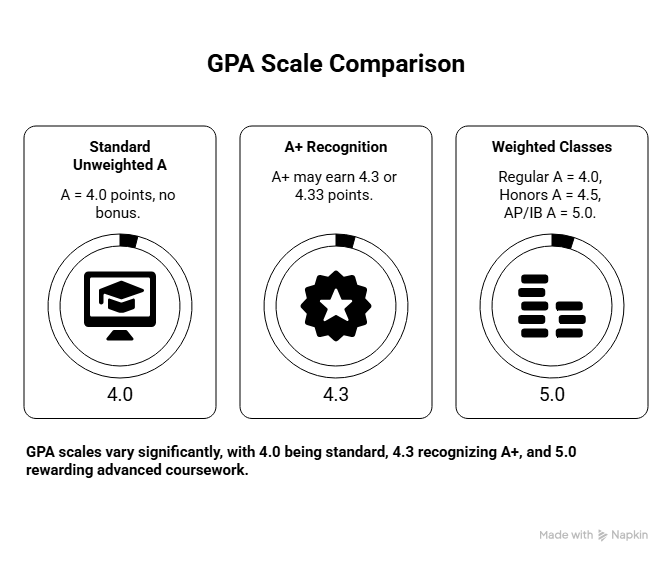
A 4.3 system may recognize an A+ differently. A 5.0 system usually gives additional weight to selected advanced classes.
For example, Rice University’s GPA policy currently assigns 4.0 to both A and A+. Before Fall 2018, Rice assigned 4.33 to an A+.
Columbia University’s registrar provides another example of a grading table that assigns 4.33 to an A+, while an A remains 4.0.
The specific institution’s grading scale determines what the numbers mean.
How Do the 4.0 and 4.3 GPA Scales Work?
The 4.0 scale is a common GPA system used by U.S. high schools and colleges.
A typical unweighted scale assigns:
- A = 4.0
- B = 3.0
- C = 2.0
- D = 1.0
- F = 0.0
Many schools also use plus/minus grades. For example, an A- may equal 3.7, while a B+ may equal 3.3.
The 4.3 scale extends the upper end of the grading system by assigning more than 4.0 points to an A+.
4.0 vs. 4.3 GPA comparison chart
| Letter Grade | Example 4.0 Scale | Example 4.3/4.33 Scale |
|---|---|---|
| A+ | 4.00 | 4.33 |
| A | 4.00 | 4.00 |
| A- | 3.67 | 3.67 |
| B+ | 3.33 | 3.33 |
| B | 3.00 | 3.00 |
| B- | 2.67 | 2.67 |
| C+ | 2.33 | 2.33 |
| C | 2.00 | 2.00 |
| C- | 1.67 | 1.67 |
| D+ | 1.33 | 1.33 |
| D | 1.00 | 1.00 |
| D- | 0.67 | 0.67 |
| F | 0.00 | 0.00 |
Example values based on published university grading systems. Some schools use 4.30 instead of 4.33, or 3.7 instead of 3.67.
Example: Does an A+ change your GPA?
Imagine a student earns these grades in three equal-credit courses:
A+, A-, and B+
On the example 4.0 scale:
(4.00 + 3.67 + 3.33) ÷ 3 = 3.67 GPA
On the example 4.33 scale:
(4.33 + 3.67 + 3.33) ÷ 3 = 3.78 GPA
The student’s letter grades did not change. Only the value assigned to A+ changed.
There is another detail worth checking. The American University of Beirut’s published grading system awards 4.3 points for an A+ but caps its reported GPA at 4.0.
An A+ worth 4.3 does not always mean a student’s reported GPA can exceed 4.0.
For a detailed breakdown of how letter grades and grade points relate, GPA to letter grade chart provides a useful reference.
How Does a 5.0 Weighted GPA Scale Work?
A 5.0 weighted GPA scale gives additional points for qualifying advanced courses. It is commonly associated with high school grading.
For example, a school might use:
- Regular class: No additional points
- Honors class: +0.5 points
- AP or IB Higher Level class: +1.0 point
Under that example policy, an A in a regular course earns 4.0 points. An A in an Honors course earns 4.5. An A in an AP course earns 5.0.
Weighted vs. unweighted GPA chart
| Letter Grade | Regular Class | Honors (+0.5) | AP/IB HL (+1.0) |
|---|---|---|---|
| A | 4.0 | 4.5 | 5.0 |
| A- | 3.7 | 4.2 | 4.7 |
| B+ | 3.3 | 3.8 | 4.3 |
| B | 3.0 | 3.5 | 4.0 |
| B- | 2.7 | 3.2 | 3.7 |
| C | 2.0 | 2.5 | 3.0 |
| F | 0.0 | 0.0 | 0.0 |
Illustrative weighting model. Schools can use different bonuses, grade restrictions, or course eligibility rules.
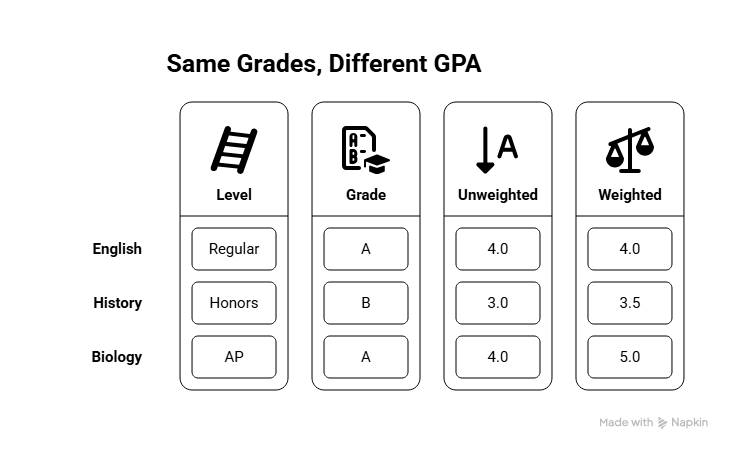
Example: Calculate the same grades on 4.0 and 5.0 scales
Suppose a student completes three equal-credit courses:
| Course | Letter Grade | Unweighted Points | Weighted Points |
|---|---|---|---|
| English — Regular | A | 4.0 | 4.0 |
| History — Honors | B | 3.0 | 3.5 |
| Biology — AP | A | 4.0 | 5.0 |
| Total | 11.0 | 12.5 |
Unweighted GPA:
11.0 ÷ 3 = 3.67
Weighted GPA:
12.5 ÷ 3 = 4.17
The student has the same three letter grades in both calculations. The weighted GPA is higher because the Honors and AP courses receive bonus points.
This example assumes equal course credits. When credit values differ, the calculation must account for those differences.
Do all high schools use the same weighting?
No. This is where comparing school-reported GPAs becomes difficult.
Some schools give Honors classes an additional 0.5 points and AP classes an additional 1.0. Others use different scales.
For example, Miami University’s admissions recalculation policy assigns different values to standard, Honors, AP, and IB coursework.
The University of California also applies its own rules for qualifying advanced courses. Its admission GPA calculation does not simply accept every high school’s weighted GPA unchanged.
For students and parents, the school’s actual weighting policy matters more than the number 5.0 itself.
If you want to examine how credits and advanced classes affect the final average, the High School GPA Calculator helps organize the calculation.
How Do You Calculate or Convert GPA Between Different Scales?
The basic GPA formula stays the same across these systems:
GPA = Total Quality Points ÷ Total GPA Credits
Quality points are calculated by multiplying each course’s grade-point value by its credits.
The scale determines the grade-point values used.
Step 1: Identify your school’s scale
Check the transcript, student handbook, or school’s published grading policy.
Find out whether it uses:
- 4.0 unweighted
- 4.3 or 4.33 plus/minus
- 5.0 weighted
- Another local GPA system
Also check how it values an A+ and which advanced courses receive extra weight.
Step 2: Calculate grade points for each course
For example, on a 4.0 scale:
An A in a 3-credit course earns:
4.0 × 3 = 12 quality points
A B in a 4-credit course earns:
3.0 × 4 = 12 quality points
Step 3: Divide total quality points by total GPA credits
Combined quality points:
12 + 12 = 24
Combined credits:
3 + 4 = 7
GPA:
24 ÷ 7 = 3.43
The calculation is identical in structure on a 4.3 or weighted 5.0 scale. You simply use the grade-point values specified by that system.
Can you convert a 5.0 GPA to a 4.0 GPA?
You can estimate an unweighted GPA if you know the original course grades, credits, and school rules.
But dividing a weighted GPA by 5 and multiplying by 4 is not a reliable official conversion.
For example:
4.2 ÷ 5 × 4 = 3.36
This is only a proportional calculation. It does not recover the student’s original unweighted grades.
Two students with identical weighted GPAs may have different unweighted GPAs because they took different combinations of regular and advanced courses.
A more meaningful comparison recalculates the underlying grades using the intended 4.0 rules.
Can you convert GPA directly to a percentage?
Not with one formula that works at every school.
For example, a B may represent 83–86% under one grading policy. Another school may use different percentage cutoffs.
A 3.5 GPA also does not automatically equal 87.5%.
GPA is built from grade-point values and often includes several courses. A percentage is based on the original grading method.
To compare a GPA with typical letter-grade values, the GPA to Letter Grade Converter provides scale-based references. Use your school’s grading policy for official results.
Which GPA Scale Should You Use for School or College Applications?
Use the GPA scale shown on your official transcript unless the application gives different instructions.
If your high school reports a weighted GPA on a 5.0 scale, do not automatically convert it to a 4.0 GPA yourself.
Colleges may ask for both the GPA and the scale used to calculate it. Some institutions also recalculate GPA using their own rules.
What should high school students check?
Before reporting your GPA, confirm:
- Whether it is weighted or unweighted.
- Which courses receive bonus points.
- Whether the school uses a 4.0, 4.3, or 5.0 system.
- What GPA scale the college application requests.
The admissions office may assess your grades alongside the courses available at your school.
A demanding course schedule can provide useful context. It does not automatically make one GPA better than another.
Is a 4.0 on a 5.0 scale a good GPA?
It can reflect strong performance, but the number alone does not tell you enough.
For example, a 4.0 weighted GPA could come from several different combinations of regular and advanced courses.
A 4.0 unweighted GPA, by contrast, generally represents the highest possible average on a standard unweighted 4.0 scale.
This is why the same GPA number should not be compared across different scales without context.
The good GPA breakdown explains how GPA expectations vary by academic goal, college selectivity, and course rigor.
What if you are comparing several semesters?
Use the same applicable grade-point policy when combining courses. Also account for each course’s GPA credits.
Simply averaging semester GPAs can produce an incorrect result when the credit loads differ.
For students combining several academic terms, the cumulative GPA calculation guide explains the credit-weighted method and common transcript discrepancies.
Final Words
The most important thing about a GPA scale is not its maximum number. It is how the school assigns grade points.
A 4.0, 4.3, or 5.0 system may value the same letter grade differently. Weighted systems also consider qualifying advanced coursework.
Before calculating or comparing GPAs, check the grading scale printed on your transcript. If you need an unweighted comparison, work from the original course grades whenever possible.
That gives you a more accurate result than assuming all GPA scales can be converted using one percentage formula.
Sources
- Columbia University Registrar — Student Grades
- Rice University Registrar — GPA Calculation
- American University of Beirut — Undergraduate Grading System
- Miami University — Recalculated High School GPA
- University of California Admissions — GPA Requirement and Honors Weighting
Frequently Asked Questions
Is a 4.3 GPA better than a 4.0 GPA?
Not necessarily. A 4.3 GPA may reflect extra points for A+ grades, while a 4.0 may be the maximum under another school’s rules. Compare the grading policies before judging academic performance.
Can you earn above a 4.0 GPA without AP classes?
Yes, if your school awards more than 4.0 points for an A+ or gives weighting to other eligible courses. Some institutions use a 4.33 grade-point value, although reported GPA limits vary.
Does an A+ always equal 4.3 GPA points?
No. Some schools assign 4.0 to an A+, others use 4.3 or 4.33, and some do not recognize A+ as a separate grade. Your school’s published grading scale determines the value.

Olivia Grant is a former K–12 teacher (12 years) and Lead Content Strategist at EasyGraderHub, holding an M.Ed. in Curriculum & Instruction from the University of Washington. She writes EasyGraderHub’s grading guides and reviews its calculators for classroom accuracy. Read more about Olivia.