
A good GPA is not one fixed number. A 3.7 can be an excellent academic record in one context, while a 3.7 on a different scale, with a different course load or grading system, may not mean the same thing
For admissions, the more useful question is: Good for what? A high school applicant targeting a highly selective university, a college student applying to medical school, and a graduate student applying to an engineering master’s program can all have very different GPA expectations.
Your GPA scale, course rigor, major, academic trend, and the institution evaluating your transcript all matter.
The key point: Do not judge a GPA by the number alone. Look at how it was earned and what the receiving institution does with it.
Key Takeaways
- There is no single GPA that is “good” for everyone. Your goal, institution, major, grading scale, and academic context all matter.
- 3.0 is solid, 3.5 is strong, and 3.7–4.0 is excellent on a traditional unweighted 4.0 scale, but these labels do not guarantee admission.
- Weighted and unweighted GPAs cannot be compared directly. A 4.2 weighted GPA and a 3.8 unweighted GPA may have been calculated under completely different rules.
- Admissions offices do not all recalculate GPA the same way. Some create their own formulas; others use transcript and school context. UC, AMCAS, and LSAC demonstrate how different evaluation systems can produce different GPAs.
- One B+ will not normally destroy a four-year GPA. Consistent performance across many credits matters much more than one isolated grade.
- For international applicants, never force a foreign grading system into a U.S. 4.0 formula without checking the receiving institution’s rules. UK classifications, ECTS, percentage systems, and CGPAs are not interchangeable.
What Counts as a Good GPA?
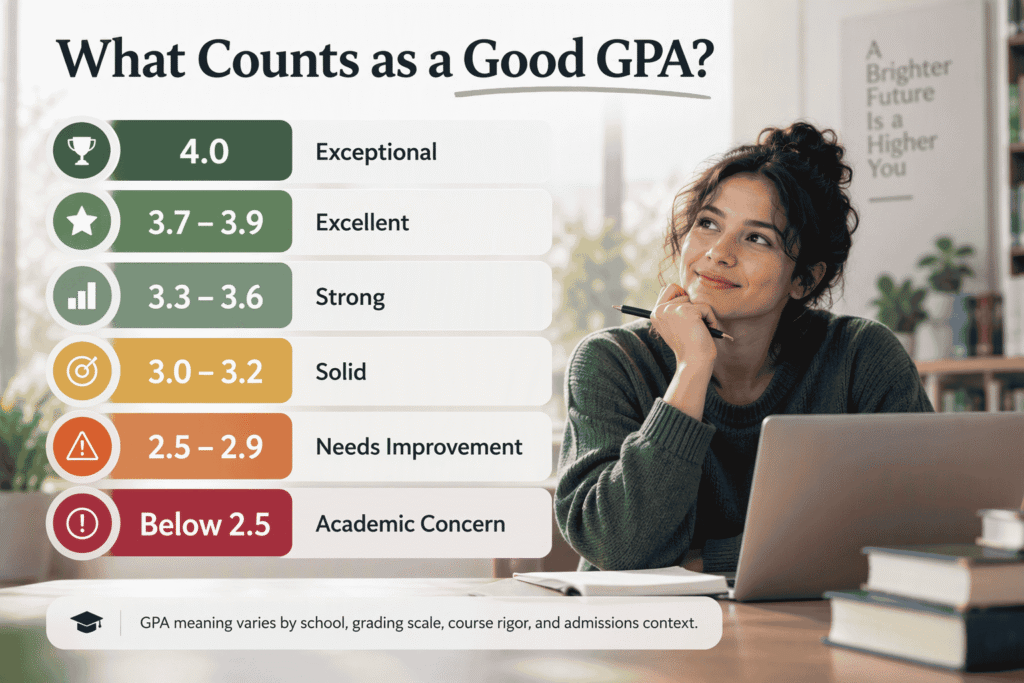
On a traditional U.S. unweighted 4.0 scale, a GPA around 3.0 is generally a solid academic average, 3.5 is strong, and 3.7–4.0 represents a very high level of performance.
That does not mean a 3.0 automatically qualifies you for every college or that a 3.8 guarantees admission anywhere. Universities set their own requirements, and highly selective admissions offices examine the entire academic record rather than applying one universal GPA cutoff.
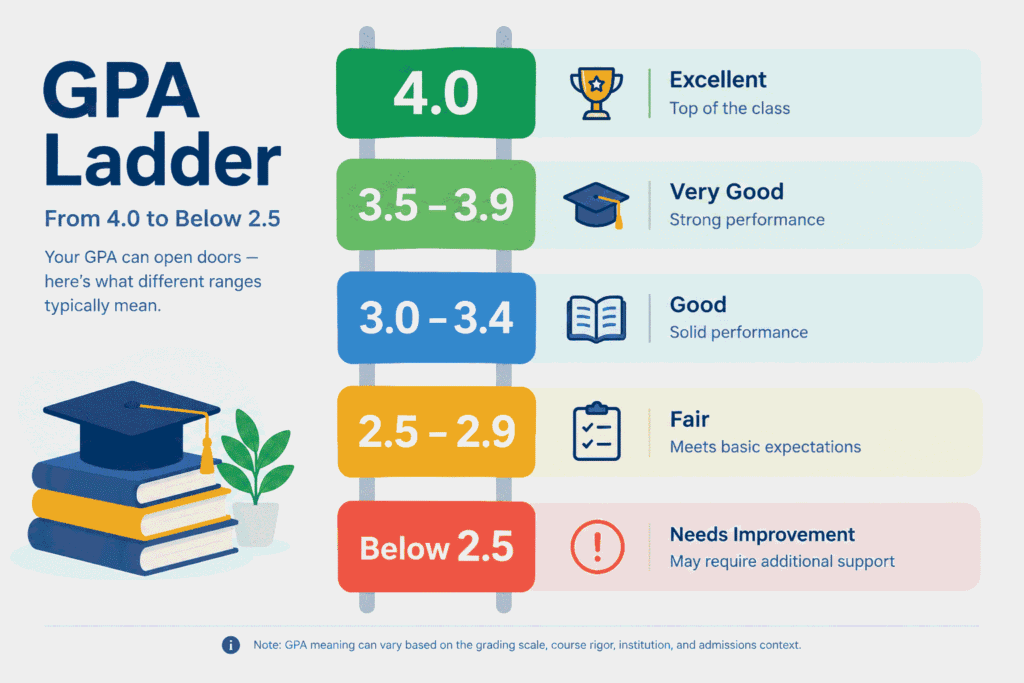
Yale, for example, says it evaluates transcripts in the context of the student’s school, available courses, curriculum, and individual circumstances. Stanford similarly says it reviews academic preparation through challenging coursework and grades in context, and states that it has no minimum GPA requirement.
So the table below should be used as a reference guide, not an admissions formula.
GPA Grade-by-Grade Reference Chart
The percentage ranges in this table represent a common U.S. grading pattern. Individual schools may use different percentage boundaries, plus/minus policies, or GPA values.
| GPA Range (4.0 Scale) | Letter Grade Equivalent | Typical Percentage Range* | Academic Standing Level | Typical Admissions Context** |
|---|---|---|---|---|
| 4.0 | A / A+ | 93–100% | Exceptional | Highly competitive academic profile |
| 3.7–3.9 | A- to A | 90–100% | Excellent | Strong for many selective programs |
| 3.3–3.6 | B+ to A- | 87–92% | Strong | Competitive at many institutions, depending on program |
| 3.0–3.2 | B to B+ | 83–89% | Solid | Meets or exceeds requirements at many colleges; competitiveness varies |
| 2.5–2.9 | B- to C+ | 77–82% | Developing | May be below typical ranges for highly selective programs |
| 2.0–2.4 | C to C+ | 70–76% | Below strong academic benchmark | Program and institution requirements become especially important |
| 1.0–1.9 | D to C- | 60–69% | Academic concern | May create admission or academic-standing restrictions |
| Below 1.0 | F to D | Below 60% | Critical academic concern | Often below minimum academic requirements |
* Percentage-to-letter relationships are illustrative, not universal.
** “Admissions context” is not a promise of admission or rejection. Colleges may use different calculations, requirements, and review methods.
For a more precise look at how individual GPA values translate into common grade expectations, see the GPA Scale and the individual guides for 3.5 GPA, 3.6 GPA, 3.7 GPA, 3.8 GPA, 3.9 GPA, and 4.0 GPA.
Important: A GPA range is not the same thing as an average percentage. A 3.5 cumulative GPA, for example, is produced by multiple grades over time; it should not be assumed to equal one exact percentage.
3.7 to 4.0 GPA: Excellent Academic Performance
A 3.7–4.0 GPA generally reflects mostly A-range work on a traditional unweighted 4.0 scale.
For a high school student, this can represent a very strong academic profile, particularly when those grades are earned in demanding courses. Yale emphasizes both strong grades and increasing academic rigor, while Stanford says its strongest applicants typically show outstanding results in a rigorous program of study.
But there is a major distinction between:
3.9 with a demanding course schedule
and
3.9 earned through a less challenging course schedule.
Admissions offices can see the difference through the transcript and school context.
Who may need this level?
Students pursuing highly competitive academic pathways—such as very selective undergraduate admissions or professional programs such as medicine and law—often have strong academic records simply because the applicant pools are academically demanding.
That does not mean there is one GPA that every pre-med or pre-law student “needs.” Medical schools and law schools use their own application services and evaluation methods. AMCAS, for example, converts many transcript grades into standardized AMCAS grades, while LSAC calculates its own standardized GPA for law-school applicants.
How to maintain a 3.7–4.0
At this level, the goal is not simply to collect perfect grades at any cost.
Protect the fundamentals:
- Take challenging courses you can realistically handle.
- Pay particular attention to courses carrying more credits.
- Watch for small declines across several semesters.
- Build a study system before workload becomes overwhelming.
- Do not sacrifice sleep and health in an attempt to turn every 3.7 into a 4.0.
A single B does not define an academic career. What matters more is the overall record and its trajectory.
Yale explicitly notes that trends matter and that recent coursework can provide useful evidence of academic preparation.
3.3 to 3.6 GPA: Strong and Above Average
A 3.3–3.6 GPA generally represents B+ to A- level work on a common 4.0 scale.
This is a strong range for many students. It can support applications across a broad range of universities and programs, although the actual competitiveness of a 3.4 or 3.6 depends heavily on the institution and field.
For scholarship purposes, do not assume that a particular GPA automatically qualifies you for merit aid. Scholarship thresholds are established by individual colleges and programs and can change from one admissions cycle to another.
Why the difference between 3.3 and 3.6 matters
Students sometimes think of these numbers as almost identical because both fall into the “good” category.
Mathematically, however:
3.6 − 3.3 = 0.3 GPA points
Across a long undergraduate record, repeated differences of that size can become significant.
For example, suppose a student completes 40 equally weighted courses:
- Student A averages 3.3
- Student B averages 3.6
The difference is:
0.3 × 40 = 12 additional grade points
That is not a small difference in the underlying academic record.
A 3.5 GPA deserves context
A 3.5 can mean:
- Mostly A- and B+ work
- A mixture of A, B, and occasional B- grades
- A weighted high school GPA that includes advanced-course points
Those are not interchangeable.
That is why students comparing GPAs should always ask:
What scale was used?
3.0 to 3.2 GPA: Solid, but Context Matters More
A 3.0–3.2 GPA is approximately B-level performance on a traditional 4.0 scale.
It is reasonable to describe this as a solid academic average, but whether it is “good enough” depends almost entirely on the student’s goal.
A 3.1 may be perfectly adequate for one institution and below the competitive range for another.
This is particularly important for:
- Highly selective undergraduate programs
- Competitive transfer admissions
- Graduate programs with strict minimum GPAs
- Professional programs with heavy academic screening
- Merit scholarships with published GPA requirements
A college may also distinguish between a 3.1 earned in a demanding curriculum and a 3.1 earned in a lighter schedule.
That is one reason admissions officers often look beyond the number.
2.5 to 2.9 GPA: A Challenge, Not a Dead End
A 2.5–2.9 GPA usually indicates a mix of B-, C+, B, and C-level performance on a common 4.0 scale.
Students in this range often need more strategic planning, but a GPA below 3.0 does not mean that further education or a successful career is off the table.
The first question should be:
Is the GPA still moving upward?
A student whose GPA went:
2.4 → 2.7 → 3.1
has a different academic story from a student whose record went:
3.4 → 3.0 → 2.6
Admissions committees can see these patterns in transcripts.
What to do next
If you are currently in this range:
- Identify which courses caused the largest GPA damage.
- Meet with an academic advisor or counselor.
- Check whether your institution offers grade replacement, academic renewal, or repeat-course policies.
- Avoid taking an unnecessarily overloaded schedule while trying to recover.
- Build the next semester around courses where you can demonstrate sustained improvement.
Do not repeat a course simply because you believe every college will replace the original grade. Repeat and grade-forgiveness policies vary by institution.
Below 2.5 GPA: Focus on Recovery and Academic Standing
A GPA below 2.5 deserves immediate attention, but it should be treated as an academic problem to solve, not as a judgment about the student’s ability.
The first task is to distinguish between:
- Term GPA
- Cumulative GPA
- Major GPA
- Institutional GPA
- GPA used for an external application service
These can be different numbers.
Also check your institution’s academic-standing rules. Many U.S. universities use a threshold around 2.0 for good academic standing, but the exact policy varies. For example, the University of Michigan–Dearborn uses 2.0 for good standing, while UC Berkeley’s published policies also use 2.0 in several academic-standing contexts.
A practical GPA recovery plan
Start by calculating exactly how much improvement is mathematically possible.
Suppose you currently have:
- 45 completed credits
- 2.60 cumulative GPA
Your current quality points are:
45 × 2.60 = 117
You want a 2.90 GPA after another 15 credits.
The target total quality points would be:
60 × 2.90 = 174
You therefore need:
174 − 117 = 57 additional quality points
Across 15 credits:
57 ÷ 15 = 3.80
So you would need a 3.80 GPA across the next 15 credits to raise the cumulative GPA from 2.60 to 2.90.
That calculation gives you something much more useful than simply saying, “I need better grades.”
Weighted vs. Unweighted GPA: Why the Number Can Be Misleading
A weighted GPA adds extra points for certain advanced courses.
An unweighted GPA does not.
A common illustrative model looks like this:
| Letter Grade | Standard Regular Class | Honors Class (+0.5) | AP / IB Higher Level (+1.0) |
|---|---|---|---|
| A | 4.0 | 4.5 | 5.0 |
| A- | 3.7 | 4.2 | 4.7 |
| B+ | 3.3 | 3.8 | 4.3 |
| B | 3.0 | 3.5 | 4.0 |
| B- | 2.7 | 3.2 | 3.7 |
| C+ | 2.3 | 2.8 | 3.3 |
| C | 2.0 | 2.5 | 3.0 |
| D | 1.0 | 1.5 | 2.0 |
| F | 0.0 | 0.0 | 0.0 |
Warning: This is an example weighting model—not a universal AP, IB, or Honors grading standard. Schools can use entirely different weighting rules.
A student could therefore report:
3.6 unweighted
and another student could report:
4.2 weighted
without either number being inherently “better” in a mathematical comparison. They were produced under different systems.
Common App materials explicitly distinguish GPA scale and GPA weighting, and current application systems support multiple GPA scales and weighted/unweighted reporting.
Do selective colleges recalculate everything to unweighted 4.0?
This is one of the most repeated—and most oversimplified—claims online.
There is no single admissions-wide rule that every selective college uses.
Some institutions create their own GPA calculations. Some use a weighted or capped formula. Some examine the transcript and school profile without reducing everything to one universal number.
The University of California provides a useful real-world example. UC calculates its own admission GPA using specified A-G courses, assigns A=4, B=3, C=2 and D=1, excludes high-school plus/minus differences from that calculation, and adds limited honors points for qualifying advanced coursework. Individual campuses may also consider other GPA versions during selection.
So the better rule is:
Never assume that an admissions office simply takes your reported weighted GPA and divides it back to a 4.0 scale. Check the institution’s actual methodology.
The Plus/Minus Difference: A- vs. B+
On a commonly used 4.0 scale:
A- = 3.7
B+ = 3.3
The difference is:
0.4 grade points
That sounds significant—and it can be—but the effect on a four-year cumulative GPA depends on how many credits you have completed.
Example: One 3-credit course
Suppose one 3-credit class changes from B+ to A-.
Difference in quality points:
(3.7 − 3.3) × 3 = 1.2
If you eventually complete 120 credits:
1.2 ÷ 120 = 0.01
So that one grade difference would change a 120-credit cumulative GPA by about 0.01.
Ten similar differences
If ten 3-credit courses differed by B+ versus A-:
1.2 × 10 = 12 quality points
12 ÷ 120 = 0.10
Now the cumulative difference is approximately 0.10 GPA points.
That is why one disappointing grade usually does not destroy a four-year GPA. Consistent patterns matter much more than one isolated result.
High School GPA vs. College GPA
The way a GPA is built changes when students move from high school to college.
In high school
GPA may be based primarily on course grades, with additional weighting for advanced classes.
A school may report:
- Unweighted GPA
- Weighted GPA
- Class rank
- GPA scale
- School-specific honors weighting
Common App asks schools to provide information about the GPA scale and whether the GPA is weighted or unweighted, helping colleges interpret the transcript in its school context.
In college
Credit hours become especially important.
A 4-credit laboratory science course contributes more to a student’s GPA than a 1-credit seminar because more grade points are attached to it.
Universities may also have different rules for:
- Pass/fail courses
- Repeated courses
- Withdrawals
- Incomplete grades
- Grade forgiveness
- Academic renewal
External application services may treat those same courses differently.
For example, AMCAS calculates many transcript grades according to its own conversion process and notes that its GPA can differ from the GPA shown by the student’s institution.
Does Your Major Change What Counts as a Good GPA?
Your major can change the context, but it does not automatically change the mathematical meaning of the GPA.
A 3.1 GPA is still 3.1.
What can change is how an admissions committee interprets the academic record.
A student applying to engineering, computer science, chemistry, or another quantitatively intensive field may have a transcript containing demanding mathematics and laboratory courses. A graduate program may also examine grades in relevant prerequisites rather than looking only at the overall GPA.
For undergraduate admissions, however, do not assume that a lower GPA automatically receives a special adjustment merely because the major is difficult.
Institutions have different review practices.
Stanford, for example, explicitly emphasizes rigorous preparation and success in challenging coursework, while Yale says it evaluates course selection and performance within the curriculum available at the student’s school.
For graduate and professional applications, read the specific program’s requirements. A program may have separate expectations for the overall GPA, prerequisite courses, major GPA, or recent coursework.
International Students: What Is a “Good” GPA Outside the U.S.?
International grading systems do not always convert neatly into U.S. GPAs.
A student may have:
- A percentage average
- A 10-point CGPA
- A 20-point scale
- A UK degree classification
- An ECTS-related transcript
- A national examination result
Trying to convert these systems using one universal formula can create serious errors.
UK and Commonwealth degree classifications
A common UK honours classification uses:
| Classification | Typical Mark |
|---|---|
| First-Class Honours | 70%+ |
| Upper Second-Class Honours (2:1) | 60–69% |
| Lower Second-Class Honours (2:2) | 50–59% |
| Third-Class Honours | 40–49% |
These boundaries are widely used, but individual university regulations can differ in calculation and borderline treatment.
It is therefore misleading to say:
70% = exactly 4.0 GPA everywhere
A UK First is a degree classification, not simply another label for an American A.
ECTS
ECTS is another area where students often see confusing online conversions.
The European Credit Transfer and Accumulation System is primarily a framework for credit accumulation and transfer. The European Commission’s ECTS guidance explains that grade conversion should use institutional grade-distribution information rather than assuming one universal grade-to-GPA formula.
That means:
ECTS credits are not GPA points.
And an ECTS grade should not automatically be plugged into a U.S. 4.0 calculator.
Why Professional Application Services May Give You a Different GPA
Your transcript GPA is not necessarily the same number used by every application service.
AMCAS
AMCAS converts many standard transcript grades to AMCAS grades during verification and states that the resulting AMCAS GPA may differ from the GPA reported by the student’s institution. The system is designed to give medical schools a standardized way to compare academic records.
LSAC
LSAC also converts grades to a standard scale so law schools have a uniform basis for comparison. It calculates undergraduate GPAs using its own rules, and specifically notes that its calculation can differ from the GPA shown by a college or university.
LSAC also has its own rules for repeated courses, withdrawals, failures, and academic forgiveness. For the 2026–27 application cycle, LSAC says college-level grades earned while a student was still in high school remain included in its GPA calculation; beginning with the 2027–28 cycle, those grades will be excluded.
That example illustrates why an applicant should never assume:
“My transcript says 3.65, so every admissions service will use exactly 3.65.”
They may not.
How to Calculate Your GPA Correctly
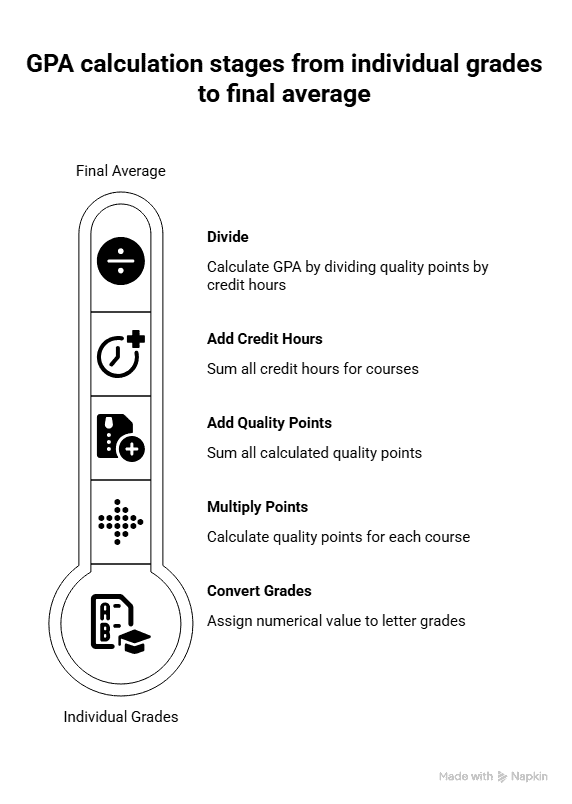
For college coursework, the standard credit-weighted formula is:
GPA = ∑ (Grade Points × Credit Hours) ⁄ ∑ Total Credit Hours
Here is a realistic four-course semester.
| Course | Grade | Grade Points | Credit Hours | Quality Points |
|---|---|---|---|---|
| Biology with Lab | A- | 3.7 | 4 | 14.8 |
| U.S. History | B+ | 3.3 | 3 | 9.9 |
| College Writing | A | 4.0 | 3 | 12.0 |
| Psychology | B | 3.0 | 3 | 9.0 |
| Total | 13 | 45.7 |
Step 1: Calculate each course’s quality points
Biology:
3.7 × 4 = 14.8
History:
3.3 × 3 = 9.9
Writing:
4.0 × 3 = 12.0
Psychology:
3.0 × 3 = 9.0
Step 2: Add the quality points
14.8 + 9.9 + 12.0 + 9.0 = 45.7
Step 3: Add the credits
4 + 3 + 3 + 3 = 13
Step 4: Divide
[45.7 \div 13 = 3.515]
Rounded to two decimal places:
Term GPA = 3.52
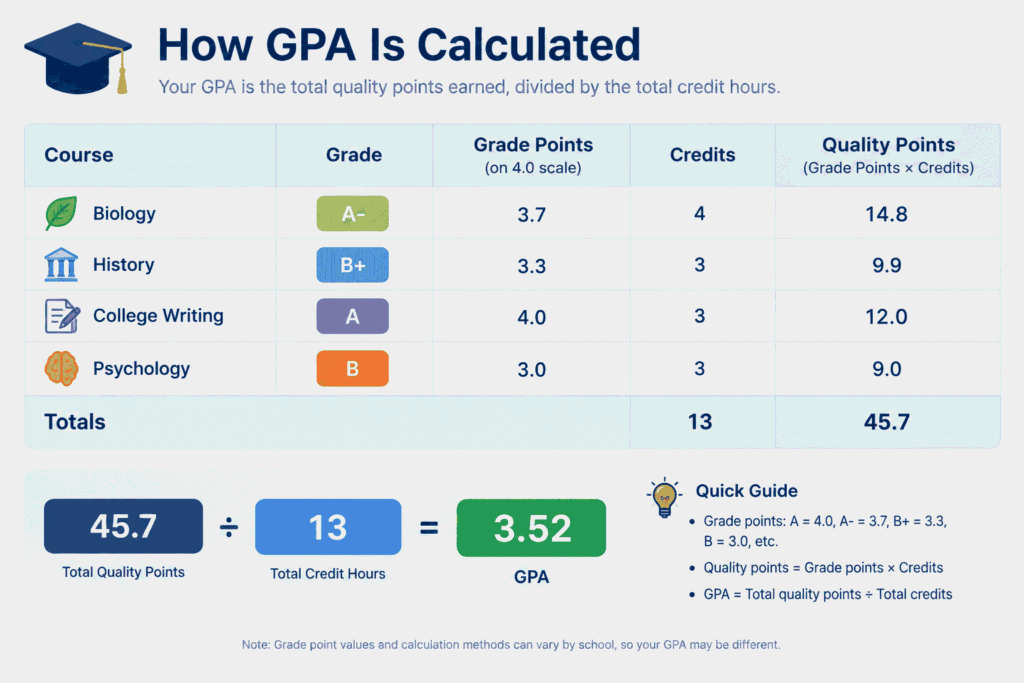
That is the basic method you can repeat for almost any credit-weighted GPA calculation, provided you are using the correct grade-point values for your institution.
For a direct conversion between GPA and letter grades, you can also use the GPA to Letter Grade Converter.
What to Do With a Borderline Grade
Suppose you receive:
89.5%
Your grading scale says:
- B+ = 87–89%
- A- = 90–92%
It is tempting to assume that 89.5 should become an A- because it is “halfway there.”
But that is not necessarily how your school calculates grades.
Check:
- The course syllabus.
- The instructor’s rounding policy.
- The official grading scale.
- Whether the final grade is rounded before or after weighting assignments.
- Whether the registrar—not the instructor—determines the official transcript notation.
Some institutions explicitly have borderline procedures for final classifications, while others simply apply the published threshold. UK universities, for example, can have formal rules for borderline degree classifications rather than relying on an informal assumption that every near-boundary mark rounds upward.
Do not change an official grade yourself because an online calculator rounds differently. The transcript and institutional grading policy control.
How to Handle a GPA Discrepancy on a College Application
Suppose your school reports:
3.82 weighted GPA on a 5.0 scale
but the college application seems to expect:
4.0 scale
Do not invent your own conversion unless the application specifically tells you to do so.
First determine:
- What GPA your school officially reports
- What scale your school uses
- Whether it is weighted
- Whether the application asks for a school-reported GPA or a recalculated GPA
- Whether the college provides its own conversion instructions
Common App’s high-school information framework specifically captures GPA scale and GPA weighting, and its school-profile approach is designed to give colleges context for different high-school systems.
Using the Common App Additional Information section
The Additional Information area should not become a second personal statement.
Use it when a brief factual explanation genuinely helps an admissions reader interpret an unusual academic record.
Appropriate examples include:
- Your school uses a nonstandard grading scale.
- Your transcript reports only percentages, not GPA.
- A significant grading-policy change affected one year.
- Your school does not offer AP, IB, or Honors classes.
- A particular course appears differently on the transcript because of school-specific policy.
- There was a major documented circumstance that materially affected your academic record.
Common App changed the Additional Information response limit to 300 words for the 2025–26 application, so students should always check the current application interface for the cycle in which they are applying.
Keep the explanation factual.
Example structure
School grading scale: My high school reports cumulative GPA on a 5.0 weighted scale. Honors courses receive an additional 0.5 points and AP courses receive an additional 1.0 point. The GPA shown on my transcript is therefore not directly comparable with an unweighted 4.0 GPA.
That is enough.
You do not need several paragraphs defending the GPA.
Explaining a GPA Problem in a Graduate or Professional School Addendum
Graduate and professional programs may provide an academic addendum, but the purpose is similar: explain relevant context clearly and briefly.
A useful structure is:
What happened → when it happened → academic impact → what changed afterward
For example:
During my sophomore year, I experienced a documented family circumstance that substantially affected my academic performance. My GPA that year fell to 2.8, compared with 3.6 during my junior year and 3.8 during my senior year. I include this context to explain the academic disruption; my subsequent coursework more accurately reflects my current academic performance.
Notice what this does not do.
It does not blame professors. It does not make excuses. It gives the reader a factual explanation and points to the subsequent academic record.
For professional applications, also remember that the application service may calculate your GPA independently. AMCAS and LSAC both have detailed rules that can produce numbers different from your school’s official GPA.
How to Raise Your GPA Strategically
Raising a GPA is a mathematical problem as much as an academic one.
The fewer credits you have completed, the faster your GPA can usually move.
For example, assume:
Current GPA = 2.80
Completed credits = 30
Current quality points:
2.80 × 30 = 84
You want a 3.20 GPA after another 30 credits.
Target quality points:
3.20 × 60 = 192
Additional quality points needed:
192 − 84 = 108
Required GPA over the next 30 credits:
108 ÷ 30 = 3.60
So you would need approximately a 3.60 average for the next 30 credits to reach a 3.20 cumulative GPA.
That is a much more realistic planning method than simply deciding that you need to “get more As.”
A simple recovery strategy
Protect your highest-credit courses. A 4-credit class can affect your GPA more than a 1-credit course.
Do not overload blindly. Five courses with poor grades are usually more damaging than a manageable schedule with consistent performance.
Use repeats strategically. Check your institution’s exact repeat and grade-forgiveness rules before deciding that retaking a course will erase the original grade.
Track your cumulative GPA every term. Don’t wait until graduation to discover that the improvement you needed was mathematically impossible.
Build an upward trend. A sustained improvement can provide useful context even when an earlier semester remains on the transcript.
Is a 3.0 GPA Good Enough for College?
For some colleges, yes.
For others, no.
There is no responsible universal answer because admission standards differ dramatically by institution, program, applicant pool, and application context.
Some universities publish explicit GPA minimums. For example, the University of California currently states a minimum 3.0 UC GPA for California residents and 3.4 for nonresidents for its first-year admission requirement, using its own GPA calculation—not simply the GPA printed by the student’s high school.
Other universities may have no published minimum and instead review the complete academic record.
So rather than asking:
“Is 3.0 good?”
ask:
“Is 3.0 competitive for the specific program I am applying to, calculated on the scale that program uses?”
That question will give you a useful answer.
Is a 3.5 GPA Good?
A 3.5 unweighted GPA is generally a strong academic average on a traditional 4.0 scale.
But its meaning changes with context.
A 3.5 earned with:
- Strong honors/AP/IB coursework
- Mostly A- and B+ grades
- An upward trend
- Strong performance in core academic subjects
tells a richer story than the number alone.
And a 3.5 weighted GPA on a 5.0 scale is not equivalent to a 3.5 unweighted GPA on a 4.0 scale.
For a detailed breakdown, see the 3.5 GPA guide.
Is a 3.7 GPA Good?
A 3.7 GPA is generally considered very strong on a traditional 4.0 scale.
It corresponds roughly to an A- average under a common plus/minus system.
For highly selective admissions, however, the important question is what stands behind the 3.7:
- How rigorous was the curriculum?
- Were advanced courses available?
- How consistent were the grades?
- Is the student improving?
- What does the school profile show?
- How does the institution calculate GPA?
Yale explicitly says it evaluates students according to the opportunities and curriculum available at their schools, while Stanford emphasizes success in challenging coursework.
Read the dedicated 3.7 GPA guide for a more specific breakdown.
Is a 4.0 GPA Always the Goal?
A 4.0 can be an excellent academic result.
It is not necessarily a reason to choose every difficult course available regardless of fit.
The better goal is:
strong grades + appropriate academic challenge + sustainable workload
A student who takes appropriately rigorous courses and performs consistently has a stronger long-term academic strategy than someone who avoids all challenge simply to protect a perfect number.
Stanford says it expects students to challenge themselves and perform at a high level, while Yale similarly emphasizes taking advantage of rigorous courses that are actually available at the student’s school.
For a detailed look at the top end of the scale, see the 4.0 GPA guide.
Final Words
A GPA is a number, but it is also a record of how you performed over time, under a particular academic system.
That distinction matters.
A 3.2 earned while taking demanding courses can tell a different story from a 3.2 produced under a lighter schedule. A 4.1 weighted GPA cannot be fairly compared with a 4.1 from another school unless you know how both institutions calculate weighting. And an international percentage cannot be converted responsibly without understanding the grading system that produced it.
For students, the most useful strategy is to stop chasing a generic definition of a “good GPA” and start measuring your GPA against the specific academic goal in front of you.
Check your institution’s grading policy. Know whether your GPA is weighted or unweighted. Understand how credit hours affect your cumulative average. And when applying to college, graduate school, medical school, or law school, follow the receiving institution or application service’s own rules rather than relying on a generic internet conversion.
That approach gives you a much clearer picture of where you stand and more importantly, what you can do next.

Olivia Grant is a former K–12 teacher (12 years) and Lead Content Strategist at EasyGraderHub, holding an M.Ed. in Curriculum & Instruction from the University of Washington. She writes EasyGraderHub’s grading guides and reviews its calculators for classroom accuracy. Read more about Olivia.