
An exam grade is your percentage score matched to a letter grade. Score 43 out of 50, and that’s 86 percent, a B on most grading scales. That part is simple math.
What trips people up is everything around that number: rounding rules, grade weighting, and the fact that schools don’t all use the same scale. Miss one of those, and a B+ can read as a B, or a strong exam can look like it barely moved the final course grade when it actually did.
That’s the short version. But an exam grade is more than one number. It has a percentage, a letter grade, and often a place inside a bigger course average. This guide covers all three, using the same math your teacher’s gradebook uses.
This guide walks through all three steps, using the same grading scale chart and rounding rules most US schools follow.
What is an Exam Grade?
An exam grade is simply a measure of how well you performed on a specific test. It shows how much of the course material you’ve mastered at a given point in the term.
Depending on how your teacher or school grades, an exam score usually shows up in one of four ways:
- Percentage: A straight scale from 0% to 100% (e.g., getting 45 out of 50 questions right equals 90%).
- Letter Grade: Standard performance letters (A, B, C, D, or F).
- Raw Points: Total points earned over points possible (e.g., 88/100).
- Grade Points: A numerical value used to figure out your GPA (like a 3.5 or 4.0).
While a test score tells you how you did on one specific day, its real importance comes from how it impacts your overall grade in the class.
Why Are Exam Grades Important?
Exams aren’t just regular assignments. They carry serious weight in how your final grade gets calculated. Here is why keeping track of them matters:
- They Heavy-Lift Your Course Average: Unlike daily homework or quick participation points, major exams usually count for a huge chunk of your syllabus (often 20% to 50% of your total grade). A single solid exam score can boost your average, while a missed or low score can pull it down fast.
- They Take the Guesswork Out of Finals: Knowing your exact exam scores gives you control over your semester. Instead of stressing near the end of the term, you can use those scores to figure out the exact grade you need on your final exam to pass or keep an A.
- They Point Out What Needs Fixing: An exam grade acts like a roadmap for your learning. It immediately shows you which topics you’ve locked down and where you might need extra review before cumulative finals or future courses.
- They Protect Your GPA & Academic Goals: Because exam scores heavily shape your final course letter grades, they directly feed into your Grade Point Average (GPA). Keeping exam scores steady helps protect scholarship requirements, sports eligibility, and college applications.
Test Score vs. Exam Grade: What’s the Difference?
A test score is just the percentage. An exam grade is what that percentage becomes once it’s matched to a letter and added into the report card.
Why does this matter? The same percentage can mean different things at different schools. Take 87 percent. That’s a B+ under a standard 10-point scale. It’s a plain B under some 7-point scales. And it’s still just a B at schools that skip plus and minus grades entirely.
If you already have the raw percentage and want to calculate a test score, turning the percentage into the letter grade that lands on the report card.
How to Calculate an Exam Grade in 3 Steps
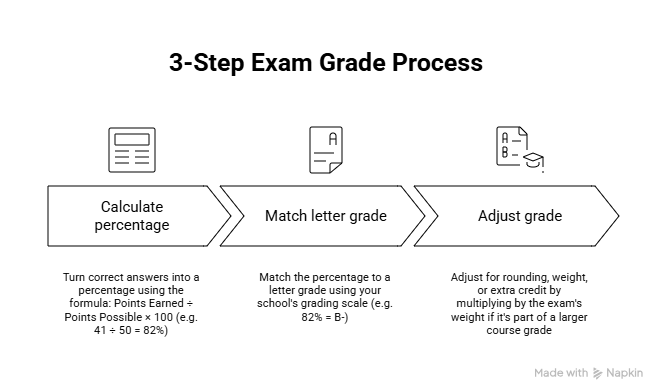
Step 1: Turn Correct Answers Into a Percentage Score
Every exam grade starts here.
Formula: (Points Earned ÷ Points Possible) × 100 = Percentage Score
Count every point the student earned. Include partial credit. Divide by the total points the exam was worth. Multiply by 100.
Example: A student scores 41 out of 50 points.
41 ÷ 50 = 0.82
0.82 × 100 = 82 percent
Some exams count questions instead of points. If every question is worth the same amount, use correct answers and total questions in place of points earned and points possible. Same formula, same result.
Step 2: Match the Percentage to a Letter Grade
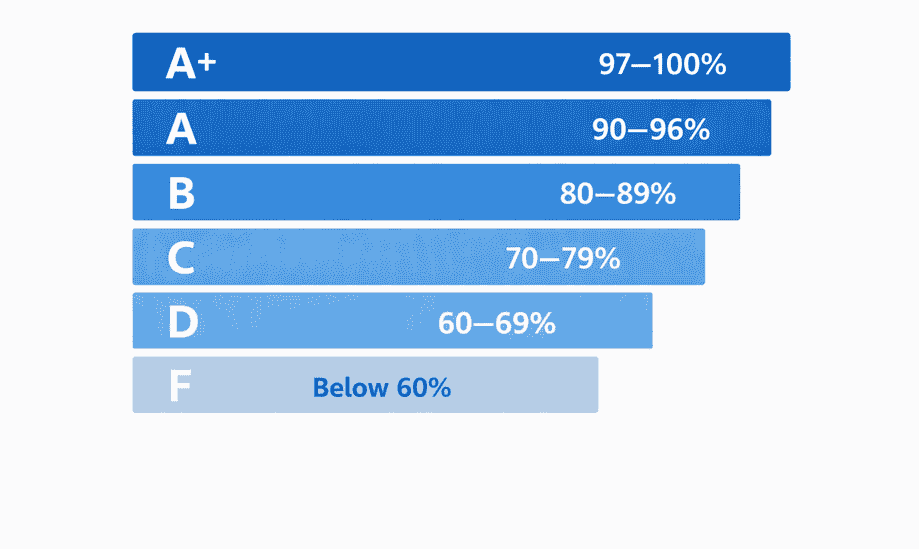
Now check the percentage against your school’s grading scale. Scales vary by school, so the syllabus or handbook always wins. Most US schools use some version of the 10-point scale below.
| Percentage | Letter Grade | GPA (4.0 scale) |
|---|---|---|
| 97–100 | A+ | 4.0 |
| 93–96 | A | 4.0 |
| 90–92 | A- | 3.7 |
| 87–89 | B+ | 3.3 |
| 83–86 | B | 3.0 |
| 80–82 | B- | 2.7 |
| 77–79 | C+ | 2.3 |
| 73–76 | C | 2.0 |
| 70–72 | C- | 1.7 |
| 67–69 | D+ | 1.3 |
| 63–66 | D | 1.0 |
| 60–62 | D- | 0.7 |
| Below 60 | F | 0.0 |
In our example, 82 percent falls in the B- range. If you’d rather skip the lookup table entirely, the Grade Percentage Chart generates the same conversion for any score automatically.
Want to know what each letter actually means, or how GPA points get calculated from there? See letter grades explained.
Step 3: Adjust for Rounding, Weight, or Extra Credit
The percentage isn’t always final. Three things can still change it.
Rounding. Many schools round to the nearest whole number and round 0.5 up. Under that rule, 89.5 percent becomes 90 and jumps from a B+ to an A-. But 89.4 percent stays a B+. Some teachers round differently, or not at all. If a grade sits close to a cutoff, check the syllabus.
Weight. If the exam is only part of the course grade, the percentage gets multiplied by its weight first. An 82 percent exam worth 30 percent of the final grade adds 24.6 points to that final grade, not 82. The Syllabus Grade Calculator handles this multiplication automatically across every graded item in a course, not just one exam.
Extra credit. Add extra points to the numerator (points earned), then redo the percentage calculation from Step 1. Don’t add points to a grade that’s already been converted to a percentage. That skips the math and gives the wrong number.
Full Worked Example
A student takes a 60-point midterm. It counts for 25 percent of the semester grade. She scores 52 points and earns 2 points of extra credit.
Step 1: (52 + 2) ÷ 60 = 0.90 → 90 percent
Step 2: 90 percent is an A- on the standard scale.
Step 3: The exam is worth 25 percent of the semester grade, so it adds 90 × 0.25 = 22.5 points toward that final grade.
That 22.5 combines with every other graded item in the course. One exam doesn’t set the whole semester grade by itself.
Common Mistakes When Calculating Exam Grades
Using the wrong scale. A generic 90/80/70 scale won’t match a school running a 7-point scale. Confirm the scale first.
Rounding before weighting. Round the final course grade, not each exam along the way. Rounding early and often stacks small errors on top of each other.
Mixing up exam grade and final grade. One exam’s letter grade is not the semester grade unless it’s the only graded item in the course. This is one of the most common mix-ups we see at home — see 5 test score mistakes parents make for this one and four others, plus how to fix each.
Forgetting the weight. Reading an 82 percent exam as if it’s 82 percent of the whole course grade, when the exam only counts for a fraction of that total, causes real confusion at conference time.
Why Grading Consistency Matters
Grading has never been perfectly consistent, even among trained teachers. In a 1912 study, researchers Daniel Starch and Edward Elliott gave the same English exam paper to 142 teachers and asked each one to grade it. The scores ranged from 50 to 98 percent — for the exact same paper. A clear formula and a published grading scale remove that kind of guesswork. That’s the whole point of using one.
Skip the Math: Use the Test Grade Calculator
Doing this by hand works for one paper. It gets slow fast for a stack of thirty. The Test Grade Calculator runs every step above in one click, and it does more than most online grade calculators:
- Questions Mode and Marks Mode. Score by correct answers and total questions, or switch to points earned and points possible for weighted exams. Same tool, either format.
- Percentage, letter grade, and GPA in one result. No second lookup table needed — the calculator shows your percentage score, letter grade, and 4.0 GPA equivalent together, plus your incorrect answer count.
- Performance Diagnostics. The calculator tells you exactly how many more correct answers would move the grade into the next letter bracket, so you know how close a B+ really is to an A-.
- What-If Simulator. Adjust the correct-answer count up or down and watch the percentage and letter grade update instantly. Useful for previewing a retake or a missed question before it happens.
- Target Grade Predictor. Type in a goal percentage, and the calculator works backward to show exactly how many correct answers are needed to hit it.
- Copy Share Link. Save or share a calculated result without re-entering the numbers later.
For scoring a full class of standard multiple-choice exams at once, the Easy Grader tool builds the whole answer key in a single pass.
Final Verdict:
Calculating an exam grade comes down to two separate decisions, not one. First, the percentage math. Second, the scale your school uses to turn that percentage into a letter. Get the first part wrong, and the whole grade is wrong. Get the second part wrong — the wrong scale, or a missed rounding rule — and the percentage is fine but the letter on the report card isn’t.
Run the numbers by hand when you want to double-check a single score. Use the Test Grade Calculator when you want the percentage, letter grade, and GPA together in one step, with a target-score check built in.
Frequently Asked Questions
The questions below cover what this article explains — how a percentage becomes a letter grade and fits into a final course grade. For calculator walkthroughs and score-by-score answers, see the FAQs on the Test Grade Calculator page.
What’s the difference between a test score and an exam grade?
A test score is the raw percentage — how many points or questions were answered correctly. An exam grade is that percentage matched to a letter on your school’s grading scale. The percentage is step one; the letter grade is step two.
Does 89.5 percent round up to a 90?
At many schools, yes. A 0.5 percent or higher usually rounds up. But some teachers use a strict cutoff with no rounding. Check the syllabus if a grade is close to the line.
How much does one exam affect my final course grade?
That depends on the exam’s weight, not the percentage alone. An exam worth 20 percent of the course grade moves the final grade far less than one worth 50 percent, even with the identical percentage score.
What if my school doesn’t use plus and minus grades?
Combine the ranges in the chart above. 90–100 becomes a flat A, 80–89 becomes a flat B, and so on.
Can extra credit change my letter grade?
Yes, if it’s added correctly. Add extra credit points to the numerator, then recalculate the percentage from scratch. Adding it to a grade that’s already a percentage skips a step and gives the wrong answer.

Olivia Grant is a former K–12 teacher (12 years) and Lead Content Strategist at EasyGraderHub, holding an M.Ed. in Curriculum & Instruction from the University of Washington. She writes EasyGraderHub’s grading guides and reviews its calculators for classroom accuracy. Read more about Olivia.