
A good test score is not one fixed number. It depends on the type of test, the grading scale, the class average, and your specific goal.
A 70% on a classroom quiz may be a passing grade. A 70% on the SAT would place a student in the bottom 1% of all test-takers. The same number means something completely different depending on the context.
This article explains how to interpret any test score accurately, from classroom quizzes to the SAT and ACT. Use the Test Grade Calculator to convert any raw score to a percentage, letter grade, and GPA instantly.
What Does “Good Test Score” Actually Mean?
A good test score is one that meets or exceeds the standard set for that specific test.
There are four standards that matter, depending on your situation:
- Passing standard: Did the student meet the minimum to pass?
- Class average: Did the student score above or below peers?
- Proficiency benchmark: Does the score show mastery of the material?
- Target score: Does the score meet a specific admissions or scholarship requirement?
None of these are the same measurement. A student can pass a test, score below the class average, fall short of the proficiency benchmark, and miss a scholarship cutoff, all with the exact same score.
Knowing which standard applies to your situation is the first step to reading a score correctly.
What is Considered a Good Grade on a Test?
In the U.S., a good grade on a test starts at 80%. That is a B on the standard 10-point grading scale used by most K-12 schools and colleges.
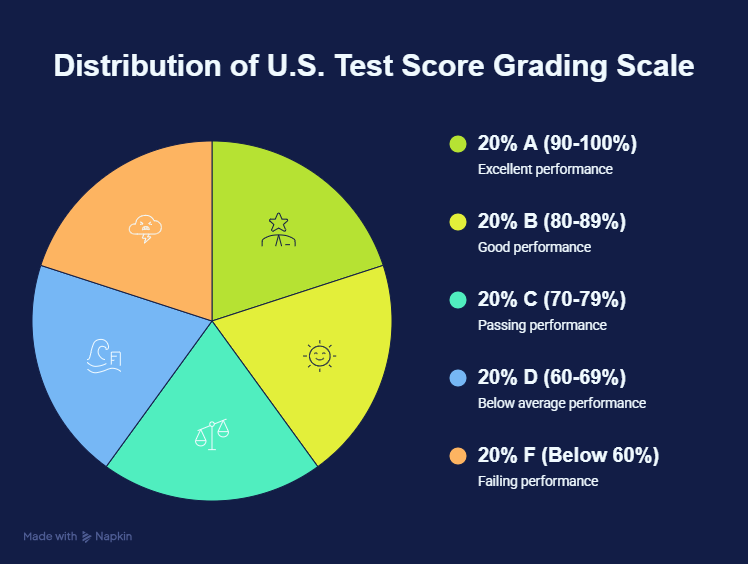
An 80% or higher tells teachers, parents, and students that the material was understood well, not just barely passed. Anything below 70% is considered a weak result in most academic settings.
The table below shows how test scores translate to letter grades, GPA values, and performance levels on the standard U.S. scale:
| Percentage | Letter Grade | GPA (4.0) | Performance Level |
|---|---|---|---|
| 93–100% | A | 4 | Excellent |
| 90–92% | A- | 3.7 | Excellent |
| 87–89% | B+ | 3.3 | Above average |
| 83–86% | B | 3 | Above average |
| 80–82% | B- | 2.7 | Above average |
| 77–79% | C+ | 2.3 | Average |
| 73–76% | C | 2 | Average, passing |
| 70–72% | C- | 1.7 | Minimum acceptable |
| 67–69% | D+ | 1.3 | Below average |
| 60–66% | D | 1 | Minimum pass |
| Below 60% | F | 0 | Failing |
Most schools use the simplified 10-point version (A=90-100, B=80-89, C=70-79, D=60-69, F=below 60). The plus/minus version above is common in middle school, high school, and college.
To verify what any raw score converts to on the standard scale, use the Test Grade Calculator.
What is a Good Test Grade in the USA?
In the U.S. education system, grading expectations differ by school level.
Elementary school (K-5): Many schools use standards-based grading instead of percentages. Levels like Proficient, Developing, and Emerging replace A-F grades. A “good” result means reaching Proficient, which signals grade-level mastery.
Middle school (6-8): Most schools switch to the traditional A-F scale. A good grade is a B (80-89%) or higher. GPA starts to matter for high school course placement.
High school (9-12): A B average (3.0 GPA) is generally considered good. An A average (3.5+ GPA) is strong for college applications. For competitive universities, class rank and weighted GPA (which factors in Advanced Placement courses) matter alongside raw test scores.
College: Most programs require a C (70%) or higher to pass a course. A B average (3.0 GPA) is considered good standing. Graduate school applications typically expect a 3.5+ GPA.
For a full breakdown of what letter grades mean at each level, What Do Letter Grades Really Mean covers the complete picture. For context on how the U.S. education system structures these levels, see How the US K-12 Education System Really Works.
Is 70% a Good Test Score?
70% is a passing grade on the standard U.S. scale. It earns a C and a 2.0 GPA. It keeps a student from failing, but it does not signal strong performance.
A student earning 70% answered roughly 7 out of 10 questions correctly. In most classroom contexts, teachers and colleges view a C as average work, not good work.
For college admissions: A 70% average is too low for most four-year universities. Selective schools expect a 3.5+ GPA (87% or higher average). Even moderate state schools typically want a 3.0 GPA (83% average).
For competitive goals like honor roll, Advanced Placement eligibility, or scholarship qualification, 70% does not meet the threshold at most institutions.
The honest answer: 70% passes. It is not good.
What is a Good Score on a Classroom Test?
For classroom tests, “good” depends on three things: the grading scale, the test difficulty, and the class average.
On a standard scale: 80% or higher is a good classroom score. It means the student understood the material beyond the minimum. 90% or higher is excellent.
Context matters: A 72% on a test where the class average was 60% is a different result than a 72% where the class average was 85%. A teacher who writes a deliberately difficult test may curve results. Score meaning is always relative to the test’s design.
Standards-based grading: In many K-5 schools, scores are replaced by proficiency levels: Exceeding, Proficient, Developing, and Beginning. On these scales, “good” means reaching Proficient. It signals grade-level mastery, not a high score in the traditional sense.
What is Considered a Good Score on a Standardized Test?
Standardized tests are not graded on the A-F scale. They use percentile rankings.
A percentile tells you what percentage of test-takers scored below you. If a student scores at the 75th percentile, they scored higher than 75% of everyone who took the same test.
| Percentile | Performance Level |
|---|---|
| 99th | Exceptional, top 1% |
| 90th–98th | Highly competitive |
| 75th–89th | Strong |
| 50th–74th | Above average |
| 25th–49th | Below average |
| Below 25th | Significantly below average |
A score that looks “low” as a percentage can be excellent as a percentile, and vice versa. A raw score of 1200 on the SAT is not 75% of 1600. It is a specific position in a national distribution of nearly 2 million test-takers.
For a clear explanation of the difference, Percentage vs Percentile Explained breaks it down in plain terms.
What is a Good SAT Score? (2026)
The SAT is scored on a scale of 400 to 1600, combining two sections: Evidence-Based Reading and Writing (200-800) and Math (200-800).
According to College Board data, the national average SAT score for the Class of 2025 was 1029 out of 1600. A score of 1350 or higher places students in the top 10% of test-takers nationally.
| SAT Score | Approx. Percentile | What It Means |
|---|---|---|
| 1500–1600 | 99th+ | Competitive at Ivy League schools |
| 1400–1499 | 95th–98th | Strong for selective universities |
| 1300–1399 | 87th–94th | Competitive at many state flagships |
| 1200–1299 | 74th–86th | Above average, solid for most colleges |
| 1029 | ~50th | National average |
| Below 950 | Below 25th | Below average |
For Ivy League schools, the middle 50% SAT range for admitted students is approximately 1480 to 1570 (College Board, 2025-2026 data). Harvard, MIT, and Stanford typically admit students scoring 1500 or above.
The key rule: A good SAT score is one at or above the 75th percentile of admitted students at your specific target school. Every school publishes this in their Common Data Set (CDS).
What is a Good ACT Score? (2026)
The ACT is scored on a composite scale of 1 to 36. Starting in 2025, the enhanced ACT made the Science section optional for online test-takers. The composite is now based on English, Math, and Reading only.
The national average ACT composite for the Class of 2025 was 19.4 out of 36, based on approximately 1.4 million test-takers (ACT.org, 2025).
| ACT Score | Approx. Percentile | What It Means |
|---|---|---|
| 34–36 | 99th+ | Exceptional, Ivy League competitive |
| 31–33 | 95th–98th | Highly competitive, selective schools |
| 28–30 | 90th–93rd | Strong, top public universities |
| 24–27 | 80th–89th | Above average, many state schools |
| 21–23 | 68th–79th | Above national average |
| 19–20 | 50th–63rd | Near national average |
| Below 17 | Below 46th | Below average |
According to U.S. News, a good ACT score is not defined by a fixed number but by how it compares to the middle 50% range at your target schools. For competitive state universities, aim for 24-27. For selective private schools, 28-30. For Ivy League programs, 33 or higher.
How Does Test Type Change What “Good” Means?
The single biggest source of confusion in test score interpretation is comparing results across different test types.
| Test Type | How “Good” Is Defined | Key Benchmark |
|---|---|---|
| Classroom quiz or test | Percentage + letter grade | 80% or higher (B or better) |
| Standards-based (K-5) | Proficiency level | At or above Proficient |
| State test (NAEP, SBAC) | Proficiency band | Proficient or Advanced |
| SAT | Percentile + school target | At or above 75th percentile for target school |
| ACT | Percentile + school target | At or above 75th percentile for target school |
| AP exam | 1-5 scale | 3 (qualified), 4-5 (well qualified) |
| GRE, GMAT, LSAT | Percentile vs graduate pool | Program-specific |
A 75% on a classroom test is a C. A 75th percentile on the SAT is a strong score that opens doors at most four-year universities. These are not the same thing. Mixing them up leads to misreading performance entirely.
Common Mistakes When Interpreting Test Scores
Treating “passing” as “good.” A 60% technically passes most U.S. courses. It earns a D and a 1.0 GPA. Passing and performing well are not the same. For college admissions, honor roll, or scholarship eligibility, a D does nothing.
Using national averages as personal targets. The SAT national average of 1029 is a data point, not a goal. Scoring at the 50th percentile means half of all test-takers did better. For most four-year college admissions, average is not competitive.
Ignoring test difficulty when judging scores. A 65% on a rigorous AP Chemistry exam may reflect stronger mastery than an 85% on a low-difficulty quiz. Washington State’s Superintendent of Public Instruction specifically warned against equating low standardized test scores with poor academic performance, noting that scores are point-in-time measurements with significant year-to-year variability per student (Washington State Standard, September 2025).
Comparing scores across different tests. A percentile and a percentage are not the same measurement. A 1200 on the SAT is not 75% of 1600 turned into a grade. It is a position in a ranked national population. Parents who mistake percentile for percentage routinely misread where their student actually stands.
For a complete look at how these misinterpretations play out in real situations, 5 Test Score Mistakes Parents Make and How to Fix Them covers each one with practical fixes.
What is Above Average on a Test?
“Above average” has a specific meaning for each test type.
- Classroom test: Above 80% (B or higher) is above average in most U.S. classrooms.
- SAT: Above 1029 is technically above average. A score of 1200 or higher (74th percentile) is meaningfully above average for college admissions.
- ACT: Above 19.4 is technically above average. A score of 24 or higher (80th percentile) is meaningfully competitive.
- State standardized tests: Above average means scoring in the Proficient or Advanced band, not just Meeting the Minimum Standard.
The difference between “above average” and “competitive” matters. Above average only tells you where you stand nationally. Competitive tells you whether you will actually get what you need at a specific school or program.
How to Know If Your Score is Good for Your Goal
Three questions settle the answer for any test score:
1. What was the test designed to measure? Unit mastery, academic readiness, or admissions competition each require different performance thresholds. A score that passes a classroom test may still fail an admissions benchmark.
2. Who are you being compared against? A class of 25 students, a state of 300,000 students, and a national pool of 2 million test-takers produce very different percentile results. Know the reference group before interpreting the number.
3. What outcome do you actually need? Passing a course, qualifying for a scholarship, and getting into a specific college each have different cutoffs. Identify the exact threshold before deciding whether a score is good enough.
Once you answer all three, “good” has a concrete definition for your situation. The Test Grade Calculator converts any raw score to a percentage, letter grade, GPA, and pass/fail status instantly.
What Score Should Students Aim For?
For classroom tests: Aim for 80% or higher. A B signals real understanding. A 90%+ (A) signals mastery and protects GPA for future course selection.
For state assessments: Aim for the Proficient band or higher. Proficient means grade-level readiness. Advanced means ahead of grade-level expectations.
For the SAT: Identify the 75th percentile SAT score of your target school’s admitted students in their Common Data Set. Score at or above that number. If your target school’s range is 1200 to 1400, aim for 1350 or higher.
For the ACT: For competitive state schools, aim for 27-30. For top-50 private universities, aim for 30-33. For Ivy League programs, 33 or higher is the target (ACT.org, 2025 data).

For AP exams: A 3 qualifies for college credit at most schools. A 4 or 5 signals strong content mastery and maximizes credit transfer value.
Conclusion:
There is no single number that defines a good test score.
A 70% passes most classroom tests and falls short of every college admissions benchmark. A 1200 on the SAT is above the national average and below the competitive range at selective universities. A 24 on the ACT is solid for most state schools and insufficient for the country’s top programs.
The right question is not “is this score good?” It is “good enough for what?”
Answer that first. Then you know the exact target, how far you have to go, and which next step actually matters.
Convert any raw score to a percentage, letter grade, and GPA with the free Test Grade Calculator. No account needed. Results in five seconds.
FAQs
What is a good test score? A good test score depends on the test type and your goal. On a classroom test, 80% (B) or higher is good. On the SAT, 1200 or higher is above average, and 1350 or higher is in the top 10%. On the ACT, 24 or higher is above average, and 28 or higher is competitive for selective universities.
What is considered a good grade on a test in the U.S.? In the U.S., a B (80-89%) is considered a good test grade. An A (90-100%) is excellent. A C (70-79%) passes but is not considered strong. Most teachers, parents, and college admissions offices treat 80% as the practical threshold for “doing well.”
Is 70% a good test score? 70% is a passing grade (C, 2.0 GPA) on the standard U.S. scale. It meets the minimum to pass. It does not meet the threshold for honor roll, advanced course placement, or competitive college admissions. Passing and good are not the same.
Is 80% a good test score? Yes. An 80% earns a B (3.0 GPA) and is above average on the standard U.S. grading scale. It indicates solid understanding of the material. For classroom tests at any level, 80% or higher is a good result.
What is a good SAT score in 2026? The national SAT average for the Class of 2025 was 1029 out of 1600 (College Board). A score of 1200 or higher is above average nationally. A score of 1350 or higher is in the top 10% of all test-takers. For Ivy League admissions, the competitive range is 1480 to 1570.
What is a good ACT score in 2026? The national ACT average for the Class of 2025 was 19.4 out of 36 (ACT.org). A score of 21 or higher is above average. A 28 or higher puts students in the top 10% nationally. For Ivy League programs, aim for 33 or higher.
What is a passing score on a test? In most U.S. K-12 schools, 60% is the minimum passing grade (D). Some schools require 70% (C) to pass. For AP exams, a 3 out of 5 is the standard threshold for college credit. Passing thresholds vary by institution, test type, and grade level.
What percentile is considered a good test score? The 75th percentile is the practical benchmark for “good” in college admissions. It means the student scored higher than 75% of the comparison group. For standardized tests, scoring at or above the 75th percentile of a school’s admitted students means the test score is working in the applicant’s favor.
Does test difficulty affect whether a score is good? Yes. A 65% on a rigorous AP exam may reflect stronger mastery than an 85% on a basic quiz. For standardized tests, score equating controls for difficulty across test dates, ensuring the same score means the same thing regardless of when the test was taken.
How do I check if a score is good for a specific college? Look up the school’s Common Data Set (CDS) online. Find the middle 50% SAT or ACT range for admitted students. If your score is at or above the 75th percentile for that school, it is competitive. If it is below the 25th percentile, consider a retake or applying test-optional at that institution.
Resources
| Source | What It Provides | URL |
|---|---|---|
| College Board (2025 SAT Annual Report) | National average SAT score 1029; percentile tables; section averages | https://satsuite.collegeboard.org/media/pdf/class-2025-student-score-distributions.pdf |
| ACT.org (2025 National Norms Report) | National average ACT composite 19.4; percentile tables; college readiness benchmarks | https://www.act.org/content/act/en/research/reports/act-publications/condition-of-college-and-career-readiness.html |
| U.S. News and World Report (August 2025) | ACT score ranges by college tier; school-specific admissions benchmarks | https://www.usnews.com/education/best-colleges/articles/whats-a-good-act-score-for-college-admissions |
| PrepScholar (February 2026) | SAT percentile rankings; good vs excellent vs poor score definitions | https://blog.prepscholar.com/good-sat-score-2026 |
| Magoosh SAT Guide (June 2026) | SAT score bands by school tier; Digital SAT section averages | https://magoosh.com/sat/sat-scores/ |
| IvyWise (April 2026) | ACT score band definitions (1-18, 19-20, 24-30, 31-36); percentile interpretation | https://www.ivywise.com/blog/good-act-score/ |
| Larry Learns ACT Guide (2026) | ACT targets by college tier; 19.4 composite context; superscoring guidance | https://www.larrylearns.com/blog/good-act-score |
| Empowerly (May 2026) | SAT score context by state; middle 50% rule explanation | https://empowerly.com/applications/exams/average-sat-scores-by-state/ |
| Washington State Standard (September 2025) | WA Superintendent quote on point-in-time score interpretation; score variability data | https://washingtonstatestandard.com/2025/09/11/washingtons-k-12-standardized-test-scores-still-below-pre-pandemic-levels/ |
| Brighterly (2026) | K-12 standardized testing statistics; 1.9M SAT takers in 2024 | https://brighterly.com/blog/standardized-testing-statistics/ |
| ThinkAcademy (July 2026) | Ivy League SAT middle 50% ranges; math acceleration and SAT correlation | https://www.thethinkacademy.com/blog/whats-a-good-sat-score-understand-compare-and-aim-for-your-best/ |
| National Center for Education Statistics (NAEP, 2025) | Nation’s Report Card; K-12 proficiency rate data | https://nces.ed.gov/nationsreportcard/ |

Olivia Grant is a former K–12 teacher (12 years) and Lead Content Strategist at EasyGraderHub, holding an M.Ed. in Curriculum & Instruction from the University of Washington. She writes EasyGraderHub’s grading guides and reviews its calculators for classroom accuracy. Read more about Olivia.