
Usually, a standard withdrawal (W) does not lower your GPA. A W normally carries no grade points, so it is excluded from the GPA calculation.
The important part is when you leave the course and what notation your school gives you. Dropping before the deadline, withdrawing later with a W, receiving a failing withdrawal, and simply stopping attendance can lead to very different results.
Quick answer: A normal W is usually GPA-neutral, but it can still affect your transcript, credits, financial aid, or academic plans.
Key Takeaways
- A standard W usually does not lower your GPA.
- A W can still appear on your transcript and count toward attempted credits.
- WF or other failing withdrawal codes may affect GPA.
- Stopping attendance without officially withdrawing can result in an F.
- Financial aid, SAP, scholarships, prerequisites, and graduation plans may be affected even when GPA is not.
- One W is usually very different from a repeated pattern of withdrawals.
- Before deciding, compare the likely grade with the withdrawal consequences. A Target GPA Calculator can help you see the GPA side of that decision.
Drop vs. Withdraw: What Is the Difference?
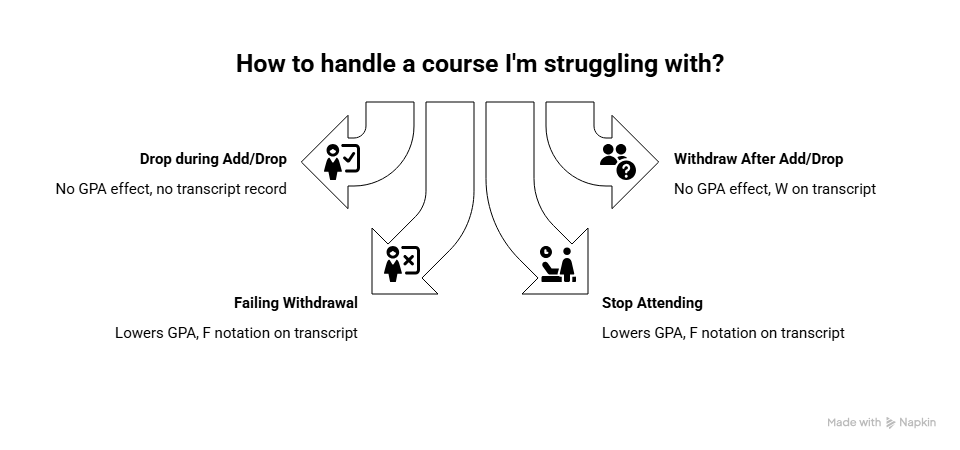
The words drop and withdraw are often used interchangeably. Colleges may treat them differently.
| Situation | Typical GPA Effect | Transcript |
|---|---|---|
| Drop during add/drop period | No effect | Often no record |
| Withdraw after add/drop | Usually no effect | Usually a W |
| Failing withdrawal (WF or similar) | May lower GPA | Failing notation |
| Stop attending without withdrawing | May result in F | F may appear |
A drop usually happens during the school’s add/drop period. The course may disappear from your schedule and transcript.
A withdrawal usually happens after that period. The school may place a W on your transcript.
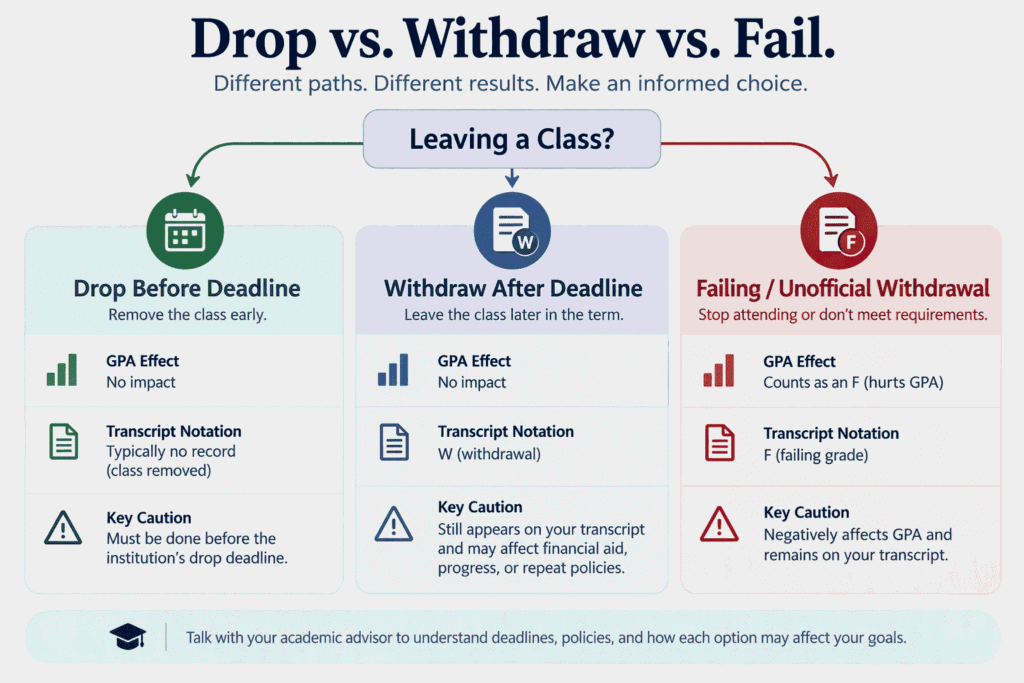
Policies vary by institution. For example, Pitt treats a standard W as having no GPA points, while UW–Madison uses different transcript notations depending on when a course is dropped.
The deadline matters
The same decision can produce different results depending on the date.
Before withdrawing, check the exact deadline for your course. Summer, accelerated, and short-session classes may have different dates.
Does a W Affect Your GPA?
Usually, no.
A standard W normally does not carry grade points. It is therefore left out of the GPA calculation.
For example, suppose you earn:
- Biology: A = 4.0
- History: B = 3.0
- Psychology: W
- English: A- = 3.7
The W is not treated as 0.0.
You should not calculate:
(4.0 + 3.0 + 0 + 3.7) ÷ 4
That would incorrectly treat the W like an F.
Instead, the school calculates GPA using the grades that count toward the GPA.
What if you receive a WF?
This is where students need to be careful.
A WF, Withdraw-Fail, or similar notation may count as a failing grade. The exact treatment depends on the school’s policy.
Professional application services may also treat failing withdrawal grades differently. AMCAS and LSAC both have their own transcript rules.
Before submitting a withdrawal, ask the registrar exactly what grade code will appear on your transcript and whether it carries grade points.
A W May Not Lower GPA, but It Can Still Matter
This is the part students often miss.
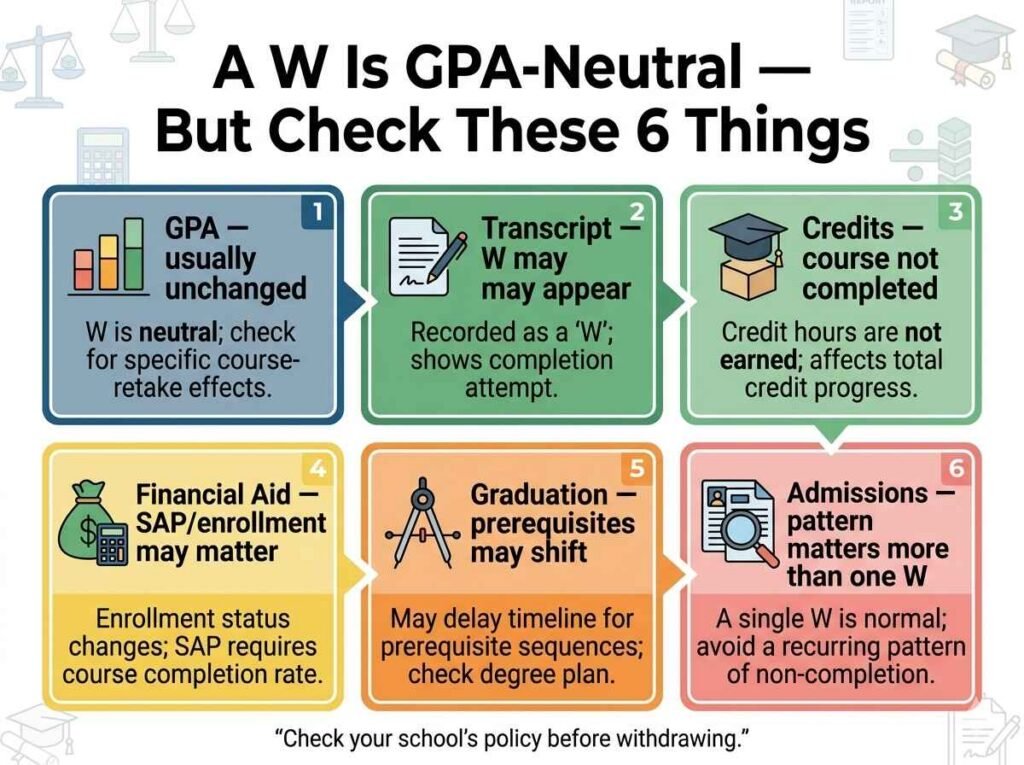
A W can remain on your transcript even when it does not change your GPA.
It may also mean that you now have fewer completed credits. That can affect your course sequence or graduation plan.
Financial aid can be affected
A withdrawal can affect Satisfactory Academic Progress (SAP) because financial-aid policies may consider your pace of completed credits.
Federal guidance specifically requires schools to explain how withdrawals affect SAP.
Dropping below a required enrollment level can also affect some forms of financial aid or student-loan status.
Scholarships can be affected
Some scholarships require a minimum GPA.
Others also require a minimum number of completed credits or a particular enrollment status.
So do not ask only:
“Will my GPA stay the same?”
Also ask:
“Will I still meet my credit and enrollment requirements?”
Prerequisites can be affected
If the class is required for a later course, withdrawing may delay your academic plan.
A three-credit W may not hurt your GPA today. It can still create a scheduling problem next semester.
Is One W Bad for College, Medical School, or Law School?
One W is not automatically a problem.
What matters is the overall transcript and the pattern of withdrawals.
One W during four years tells a different story from repeated withdrawals in several semesters.
Medical-school applicants should also remember that AMCAS uses its own GPA and transcript rules. A standard W normally does not enter the AMCAS GPA, although certain failing or administrative withdrawals may be treated differently.
Law-school applicants face a similar issue with LSAC. LSAC performs its own transcript summarization and GPA calculation, so its GPA may differ from the number shown by your college.
Admissions readers may consider:
- Number of withdrawals
- Timing and pattern
- Course difficulty
- Whether the course was a prerequisite
- Grades in later semesters
- Overall academic trend
A single W is therefore not the same as an F, and it should not automatically be treated as an academic failure.
Should You Withdraw From the Class?
There is no universal answer.
A withdrawal may make sense when continuing is likely to produce a much lower grade and the W will not create a larger problem.
Before deciding, ask these five questions:
1. What is my realistic final grade?
Use your current grades and remaining assignments, not your best-case hope.
2. What will appear on my transcript?
Confirm whether you will receive no record, W, WF, or another code.
3. Will I still meet my credit requirements?
Check prerequisites, graduation requirements, and full-time status.
4. Could financial aid or scholarships change?
Ask financial aid before reducing your enrollment.
5. What happens to my GPA either way?
Compare the likely course grade with the GPA effect of withdrawing.
For students planning a specific cumulative GPA, a Target GPA Calculator can help estimate how future grades could change the overall average.
Example
Suppose you have a 3.40 GPA and are struggling in a 3-credit course.
If you expect a D, the course may pull your GPA down significantly.
If your school allows a normal W, the withdrawal may leave the GPA unchanged.
But if the course is required for graduation, you still need to complete it later.
That is the real trade-off.
Final Words
A withdrawal is not automatically good or bad for your academic record.
A normal W usually protects your GPA from the grade-point effect of the course. It does not, however, erase the course from your academic planning.
Check the deadline. Confirm the transcript notation. Ask about financial aid. Check whether the course is a prerequisite.
Most importantly, do not stop attending and assume the school will convert the course to a W. Complete the official withdrawal process if you decide to leave.
For GPA planning, you can also review the GPA Scale or calculate your current average with the Cumulative GPA Calculator.
The best decision is the one that protects your academic progress as a whole, not just the GPA number on your transcript.
Resources
- AAMC / AMCAS: Grades and GPA calculations
- LSAC — Transcript summarization and GPA rules
- U.S. Department of Education: Satisfactory Academic Progress and withdrawal rules
- University of Pittsburgh: Monitored withdrawal and W grading policy
- UW–Madison Registrar: Drop and withdrawal policies

Olivia Grant is a former K–12 teacher (12 years) and Lead Content Strategist at EasyGraderHub, holding an M.Ed. in Curriculum & Instruction from the University of Washington. She writes EasyGraderHub’s grading guides and reviews its calculators for classroom accuracy. Read more about Olivia.