
Extra credit is one of the most misunderstood parts of grading. I’ve seen students assume that a few bonus points will automatically turn a low score into an A. While, others ignore extra credit completely because the calculation feels confusing. In reality, extra credit can be a powerful grade recovery tool, but only when you understand how it actually affects your final grade.
The biggest mistake? Treating all extra credit the same. The impact depends on how your teacher applies bonus points. It varies between point based systems and weighted grading structures. From analyzing real classroom grading methods, it’s clear that most errors happen when students don’t account for how extra credit fits into the overall grading formula.
After analyzing real grading systems and teacher grading workflows, I found that extra credit works differently across point based and weighted systems and that’s where most calculation mistakes happen.
This step by step guide shows you how to calculate grade with extra credit using the exact formulas teachers use. You’ll learn how to add extra credit to final grade and how bonus points affect your score. Whether your class uses point-based grading or weighted grading, you’ll see how to calculate extra credit in high school vs college systems. By the end, you’ll know exactly how much extra credit changes your grade and whether it’s worth your time.
This guide helps:
- Students trying to improve their final grade
- Parents who want clarity on grading systems
- Teachers who need a consistent grading approach
Key Takeaways
- Add bonus points to your earned points, then recalculate your percentage score. This gives your updated final grade instantly.
- Extra credit gives a grade boost, but the impact depends on your current grade, total points, and how close you are to your target grade.
- In weighted grading, extra credit usually affects one category (like exams), so always check your syllabus grading breakdown first.
- In point based grading, extra credit increases your score directly; in percentage based systems, the change may be smaller.
- Your final result can shift after letter grade conversion, especially with grade rounding rules or grade cutoffs.
- If you’re unsure how much extra credit will change your grade, use an grade calculator with extra credit or grade calculator to get a quick, accurate grade projection.
- Extra credit helps most when you’re close to a passing grade or trying to improve your B without retaking exams.
What are Extra Credit and Bonus Points?
Extra credit refers to optional points added to your earned score, usually through bonus assignments, participation, or special tasks. These points act as a grade boost, increasing your overall percentage or total points.
In most grading systems, extra credit is not part of the required coursework. Instead, it functions as a grade recovery tool or performance enhancer, helping students improve their final results. Schools don’t all count bonus points the same way. Some add extra credit to earned points, others treat it as a percentage boost, and many cap the final score at 100%. That confusion creates two problems: students overestimate the grade boost or skip the work entirely
Blackboard Learn explains that extra credit can be added as points, category weight, or total grade adjustment depending on grading setup.
Common types of extra credit work
Extra credit can be structured in different ways depending on the teacher or institution:
- Bonus questions on exams
- Optional assignments or projects
- Class participation or attendance rewards
- Correction based improvements (fixing mistakes for partial credit)
What are Bonus Points?
Bonus points are additional marks added to existing assignments or exams. While extra credit and bonus points are related, they are not identical. Extra credit usually refers to optional opportunities outside the required coursework, whereas bonus points are tied directly to specific tasks or scores within the grading system.
The key difference is:
- Extra credit expands beyond the standard grading structure.
- Bonus points are integrated into specific assignments or exams.
How Extra Credit Affects a Final Grade?
Extra credit does not always work the way most students expect. Its impact depends on how it is applied within your grading system.
In many cases, extra credit increases your earned points but does not increase the total possible points. This is why even a small number of bonus points can noticeably raise your percentage score.
However, there are important exceptions:
- Extra credit may not change the total points, only your earned score
- It can sometimes push your grade above 100%, depending on grading rules
- In weighted grading systems, extra credit may be limited to a specific category and have less impact overall
Because of these variations, the same extra credit assignment can affect grades very differently across courses.
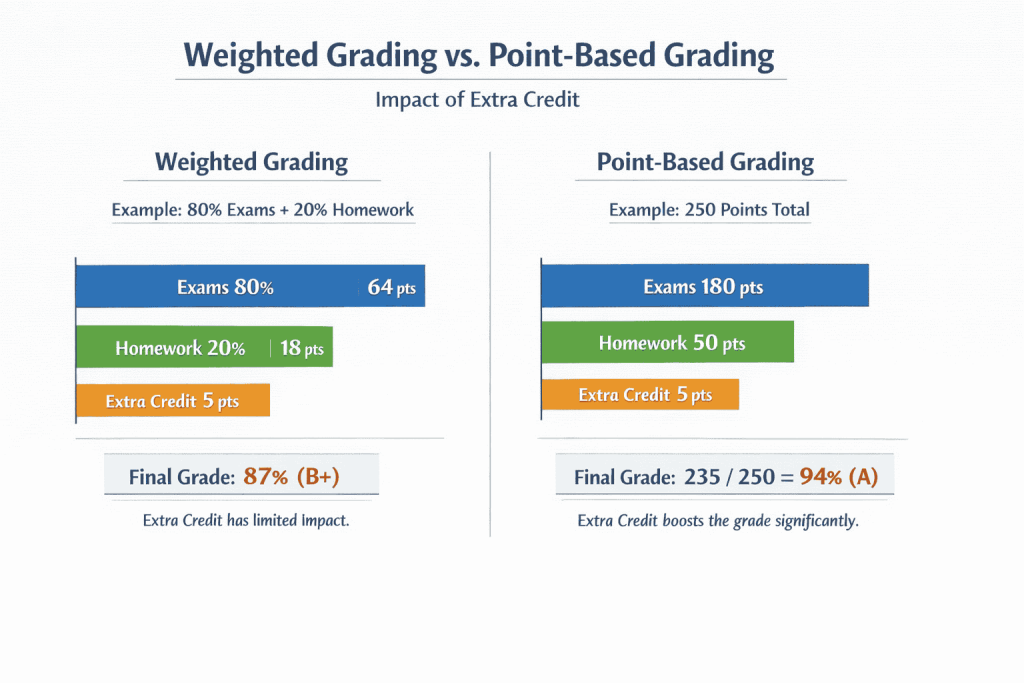
Understanding how your grading system handles bonus points is critical before calculating your final result.
To understand how grading systems apply these changes across assignments and categories, it helps to look at how grading structures are defined in real courses. A clear syllabus grading breakdown explains how each component contributes to your final score and prevents common calculation errors.
How to Calculate Extra Credit in Your Final Grade
From working with grading tools and reviewing hundreds of student scenarios, one pattern is clear: most people overestimate how much extra credit will improve their final grade.
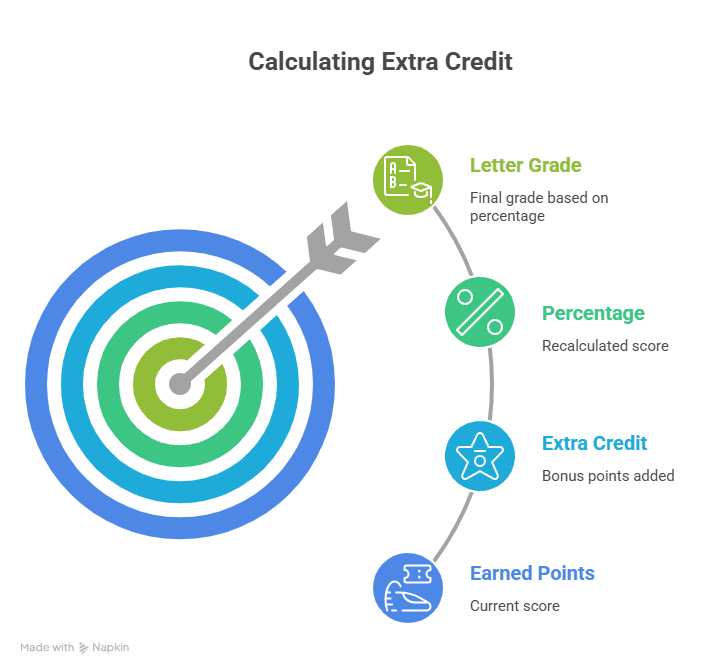
The method is simple but the impact depends on how your course is structured.
Step 1: Find your current grade
Start with two numbers:
- Earned points
- Total points
Example:
85 ÷ 100 = 85% current grade
If you’re unsure about percentage accuracy, especially when dealing with multiple tests, many students quickly verify their numbers using an exam score calculator to avoid small but costly mistakes.
Step 2: Identify your extra credit (bonus points)
Check how your teacher awards extra credit:
- Fixed bonus points (most common)
- Percentage boost (less common)
Example: +5 bonus points
This step matters because different formats affect your final grade calculation differently.
Step 3: Add extra credit to earned points
Now update your score:
85 + 5 = 90 earned points
In point based grading, this directly improves your total. In percentage based grading, the effect may feel smaller depending on total points.
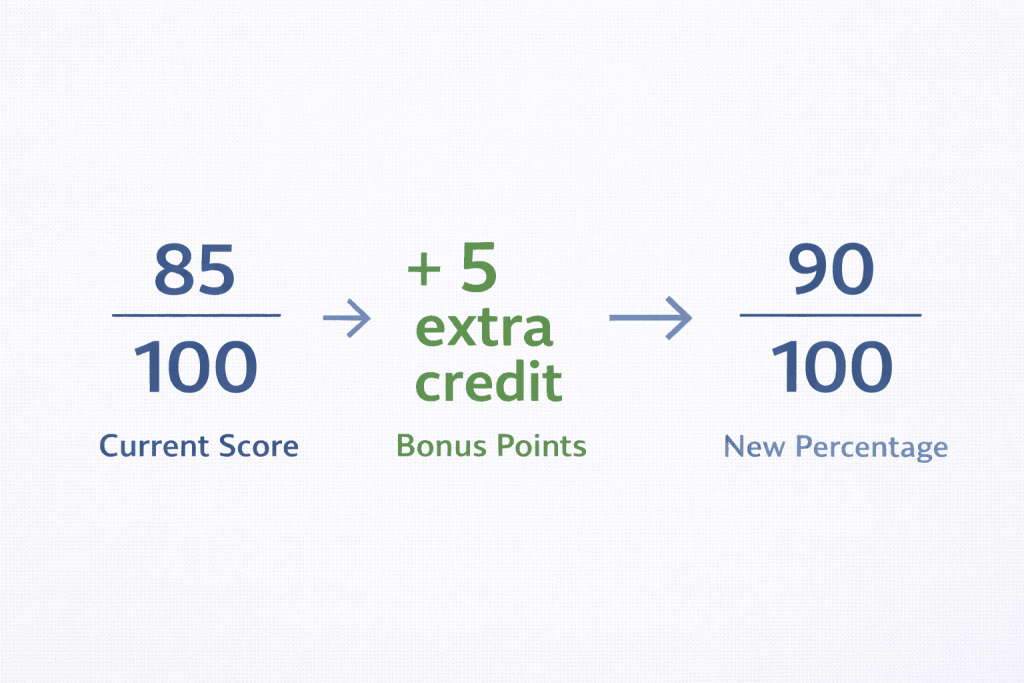
Step 4: Recalculate your percentage score
Divide again using updated values:
90 ÷ 100 = 90%
This is your new final grade with extra credit.
Step 5: Convert to a letter grade
Most schools follow standard letter grade conversion:
- 90–100% → A
- 80–89% → B
- 70–79% → C
Percentages tell you where you stand, but they don’t always explain what each letter grade means in practice. For example, an A often signals mastery, while a C may indicate basic understanding. Gaining a clear view of letter grading system helps students and parents confirm how bonus points can shift a score into the right grade bracket.
How Do You Add Extra Credit to a Final Grade?
Extra credit can be applied in different ways depending on your teacher or grading system. Understanding these methods helps you calculate your grade correctly. There are three common ways teachers apply extra credit:
1. Bonus Points (Most Common Method)
Extra credit is added directly to your earned points without increasing the total possible points.
- Added to earned points
- Total points stay the same
2. Percentage boost
Some teachers increase your final percentage instead of adding points. For example, adding 2–5% to your overall score.
- Direct increase to your percentage
- Example: 80% → 85%
3. Capped or uncapped grades
Extra credit may be applied to a specific category, such as homework or exams, rather than the entire course grade. Each method affects your final grade differently, so it’s important to confirm how your instructor applies extra credit before calculating results.
- Some teachers allow scores above 100%
- Others apply strict grade caps
From experience, high school teachers often use point based grading, while college courses follow a strict syllabus grading breakdown with fixed rules.
How to Calculate Weighted Grade With Extra Credit?
Weighted grading systems require a slightly different approach because each category contributes a specific percentage to your final grade. This is where most confusion happens and where extra credit often has less impact than expected.
Step 1: Understand your course weights
Check how much each category (homework, quizzes, exams) contributes to your final grade.
Example:
- Homework → 20%
- Quizzes → 20%
- Midterm → 25%
- Final Exam → 35%
This is your course weight structure.
Step 2: Apply extra credit to the correct category
Add extra credit only to the category where it is assigned. Extra credit usually affects only one category, not your entire grade.
Example:
If bonus points improve your quiz score, only the quiz category (20%) changes. This is why students asking “can extra credit raise my final grade?” often get surprised—it doesn’t always move the full average.
If a quiz score increases due to bonus points, that change affects the weighted average for the quiz category. To understand how different assignments contribute to your overall grade, it helps to look at how assignment weights are applied in a typical syllabus.
Step 3: Recalculate the weighted total
Multiply each category score by its weight and calculate the total.
- Quiz: 90% × 20%
- Homework: 85% × 20%
Then add all categories to get your final grade with extra credit. To avoid manual errors in weighted grading, many educators use structured tools like a syllabus grade checker, especially when handling large classes or multiple categories.
Step 4: Check the final weighted percentage
Here’s the reality from actual grading scenarios:
- A +5 bonus rarely changes a full letter grade
- It helps most with grade recovery near a passing grade
- Impact depends on:
- Total points
- Exam weighting
- Current grade position
If you’re wondering “how much will extra credit change my grade” or “how do I know if extra credit helps enough”, the only reliable way is to run a quick grade projection using a dedicated extra credit calculator.
After recalculating:
- You get your updated final weighted grade
- This reflects the true impact of extra credit
From experience, most students overestimate how much extra credit will help. A +5 point bonus does not always mean a full grade jump. The impact depends on:
- Total points in the course
- Category weights
- Current grade position
Because these factors vary, the best way to see the real effect is to run the numbers. For precise answers, many students and educators use an grade boost calculator to simulate their scenario and instantly see how bonus points change the outcome.
Key Insight (What Most Students Get Wrong)
Extra credit is not a shortcut, it’s a small optimization tool. In weighted grading systems, extra credit only affects the category where it is applied. For example, if exams are worth 40% and homework is worth 20%, adding extra credit to homework will have a smaller impact on your final grade. This is why extra credit sometimes feels less effective in weighted courses compared to point based systems.
How to Calculate Extra Credit in High School and College
High school grading rules
In most high school classrooms, extra credit follows a point based grading system. Teachers typically add bonus points directly to your earned points, which creates a visible grade boost in your percentage score. For example, if your current grade is based on 80 out of 100 points and you earn 5 extra credit points, your updated score becomes 85 out of 100.
When learning how to calculate extra credit in high school, always check whether your teacher uses:
- Fixed bonus points
- Optional assignments for grade recovery
- Capped grading policies
High school grading is usually simpler, but grade caps and grade rounding rules can limit how much extra credit improves your final result.
College grading rules
College grading is more structured and often tied to course performance, academic grading policy, and sometimes even course credit hours. Extra credit may be:
- Added to a specific category (like exams or assignments)
- Applied as a percentage increase
- Limited to certain conditions
When understanding how to calculate extra credit in college, you must consider:
- Weighted grading systems
- Syllabus-defined categories
- Stricter grading policies
Unlike high school, extra credit in college may not significantly change your semester grade unless it affects a heavily weighted category.
Key Difference
In college courses, extra credit is often controlled by syllabus rules. Instructors may apply grade caps or restrict how bonus points affect the final grade, making the impact less predictable. Because grading policies vary, always check your course syllabus before calculating how extra credit will affect your grade.
In many college courses, grades are influenced by course credit hours and detailed syllabus grading breakdowns. This means extra credit must be applied carefully within the grading structure.
For example:
- A 5-point bonus in a low-weight assignment may have minimal impact
- The same bonus in a major exam category can significantly affect your final grade with extra credit
Understanding how to calculate weighted grade with extra credit becomes essential in these systems.
Why policies vary by class and instructor
Extra credit is not standardized. Each instructor defines how it works based on:
- Course objectives
- Grading philosophy
- Institutional policies
This is why students often ask:
- How do teachers count extra credit
- Does extra credit count toward final grade
The answer depends entirely on the class. Always review the syllabus before assuming how extra credit will be applied.
Use an Extra Credit Grade Calculator to Track Your Grade
When to use an online calculator
Manual calculations work for simple cases, but errors increase when dealing with weighted grading, multiple categories, or complex scoring systems.
An extra credit grade calculator or grade calculator becomes useful when:
- You want accurate final grade calculation
- You are working with multiple assignments
- You need quick grade projection
What inputs the calculator needs
Most calculators require basic inputs:
- Current grade (percentage or points)
- Earned points and total points
- Extra credit value
- Category weight (if using weighted grading)
If you’re working with test scores or raw marks, use a test score calculator to convert results before adding extra credit.
How the calculator shows your new grade
A good calculator will display:
- Updated percentage score
- Letter grade conversion
- Difference from your previous grade
- Impact on your target grade
How to project whether extra credit is enough
One of the biggest advantages of using a calculator is grade projection. You can test scenarios like:
- How much will extra credit change my grade
- Can extra credit raise my final grade
For complex courses with weighted categories, use a syllabus-based calculator.
Common Mistakes to Avoid
Many students miscalculate extra credit because they overlook how grading systems actually work.
Avoid these common mistakes:
- Adding extra credit to the wrong category in weighted grading systems
- Confusing bonus points with percentage increases
- Ignoring grade caps that limit the maximum possible score
- Miscalculating weighted grades when multiple categories are involved
- Assuming extra credit will always improve your final grade
Understanding these mistakes helps you calculate your grade more accurately and avoid unrealistic expectations about how much extra credit can help.
Final advice before using extra credit for grade recovery
Extra credit can be helpful, but it’s not a guaranteed solution. Its impact depends on:
- Your current grade position
- The total points in the course
- Category weights and exam weighting
Extra credit is not a guaranteed grade fix. Its impact depends entirely on how your course grading system is structured. Before relying on extra credit, it’s wise to test your scenario. Many students and teachers use an extra points calculator to quickly see how bonus points affect their final grade and whether the effort is truly worth it.
Conclusion
Extra credit can improve your final grade—but only when you understand how to calculate extra credit in your final grade correctly. The actual impact depends on how your course applies bonus points, whether through point based grading or weighted grading systems.
By learning how to calculate grade with extra credit and applying accurate final grade calculation methods, you avoid common mistakes that reduce your grade boost potential. In some cases, even a small increase in earned points can significantly raise your percentage score and improve your letter grade. In other situations, the effect may be limited due to course weight, exam weighting, or strict academic grading policy rules.
Before relying on extra credit, always review your syllabus grading breakdown, including grade caps, grade rounding rules, and how instructors handle optional assignments. This helps you understand how much will extra credit change my grade and whether it supports your target grade or overall course performance.
When used strategically, extra credit t becomes a reliable tool for grade projection, smarter planning, and effective grade recovery, especially when supported by an accurate bonus points calculator or final grade calculator.
When used strategically, extra credit is more than an add‑on. With an extra credit calculator or final grade calculator, it becomes a reliable tool for grade projection, smarter planning, and effective grade recovery.”
Resources:
- Grading Policies – U.S. Department of Education
- Making Extra Credit Meaningful – Edutopia
- Weighted Grading Models – Journal of Educational Assessment
- Grade Calculator Tool – Calculator.net
FAQs: How to Calculate Extra Credit in Final Grade
How do I calculate extra credit?
Add the extra points to your earned score, then divide by the total possible points. When you’re dealing with multiple assignments or want to avoid manual errors, many students and teachers rely on an extra credit grade predictor to instantly see the exact grade boost.
How does extra credit work?
Extra credit adds bonus points to your score, either within a specific assignment or to the overall total. The impact depends on whether your grading system is point based or weighted.
How to calculate extra credit into final grade?
First, include the bonus points in your earned marks. Then recalculate your percentage using the course grading formula. In more complex grading setups, educators often combine this step with a syllabus-based approach to ensure weights are applied correctly, similar to how a syllabus grade calculator handles category weighting.
How to calculate final grade with credits?
Multiply each assignment or course grade by its credit (weight), then add them together and divide by total credits. This weighted method is commonly used in schools and aligns with how GPA calculations are structured.
How do you calculate your credits?
Credits represent how much a course or assignment counts toward your final result. To calculate, multiply your score by its credit value and divide by total credits. This is the same principle used when calculating GPA across subjects.
What is 0.500 credits?
0.500 credits means half a course. It carries 50% of the weight of a full (1.0) credit class when calculating final grades or GPA.
How much is 20% of a final grade?
Multiply your score by 0.20. For example, scoring 80% on a test worth 20% of your grade contributes 16% to your final result.
How much does extra credit increase your grade?
It depends on your current score, total points, and grading structure. Extra credit has the biggest impact when you’re close to a grade boundary, where even small increases can shift your final letter grade.
Is extra credit worth it?
Yes. Extra credit worth, especially if you’re near the next grade bracket. Even a small boost can improve your overall average and strengthen your final grade result.
Do teachers always include extra credit in final grades?
Not always. Some apply it to specific assignments, while others add it at the end. To keep grading consistent and efficient, especially in large classes, many educators use structured grading tools that save time and ensure accuracy without adding extra workload.

Olivia Grant is a former K–12 teacher (12 years) and Lead Content Strategist at EasyGraderHub, holding an M.Ed. in Curriculum & Instruction from the University of Washington. She writes EasyGraderHub’s grading guides and reviews its calculators for classroom accuracy. Read more about Olivia.