

If you’ve ever asked yourself, “how much will extra credit raise my grade?”, you’re not alone. It’s one of the most common questions students, parents, and even educators debate. It becomes especially important when grades sit just below a key threshold. On paper, extra credit feels like a shortcut. Do a little extra work, gain a few points, and suddenly your grade jumps. But in practice, the math tells a very different story.
Why Extra Credit Doesn’t Increase Grades as Much as You Think
From analyzing real classroom grading systems and testing multiple scenarios using a grade calculator, I’ve seen a consistent pattern: extra credit rarely delivers dramatic improvements unless very specific conditions are met. The reason comes down to how modern grading system works. Most schools use either points-based grading or weighted grading systems, both of which dilute the impact of small bonus assignments.
Think about it this way. If your course has 1,000 total points and you earn 10 extra credit points, that’s only a 1% increase at best and often less if those points don’t change the denominator. That’s why students frequently wonder, “why doesn’t extra credit raise my grade much?” The answer lies in scale and structure, not effort.
There’s also a psychological factor. Extra credit feels like progress because it’s optional and often easier than core assignments. But in terms of academic performance improvement, it’s usually a low leverage strategy compared to improving test scores or major assessments. This becomes even more obvious in weighted grade formula systems, where categories like exams carry far more influence than minor assignments.
That doesn’t mean extra credit is useless. It can be powerful, but only when used strategically. Throughout this article, I’ll break down exactly how much does extra credit increase your grade, using real examples, practical calculations, and insights from actual grading systems so you can make smarter decisions instead of relying on guesswork.
Key Takeaways:
- Extra credit rarely gives big jumps. In most scoring systems, it increases your grade by just 1–5%, especially in large cumulative grade calculations.
- It works best near grade boundaries. If you’re at 69% or 89%, even small bonus points can push you into the next letter grade.
- Know the difference: bonus points vs grade replacement. Extra credit adds points, but test retakes replace low scores—and usually have a much bigger impact.
- Check where it’s applied. Teachers often apply extra credit within assessment categories (like homework), which limits its effect due to weighted grading.
- Use a calculator before doing the work. An extra credit percentage increase calculator helps you quickly see if the effort is worth it or not.
- High school vs college impact is different. If you’re wondering how will extra credit points raise my grade in high school, the answer is: usually more than college, where grading is stricter.
- It won’t fix a failing grade alone. Large gaps require improving core performance—extra credit is just a support, not a recovery plan.
- Follow the policy carefully. Always check if extra credit counts toward final exam or not—this depends on rubric-based grading, academic fairness rules, and how teachers apply extra credit to grades.
- Focus on effort where it matters most. Smart students align student effort vs grade outcome—prioritize high-weight tasks, then use extra credit for final boosts.
How much can extra credit affect your grade? (Real Examples)
Small vs. Large Extra Credit: Actual Grade Change Calculations
Let’s get straight into the numbers, because this is where expectations usually collide with reality. Suppose your class uses a points-based grading system, and your current grade looks like this:
- Total points possible: 800
- Points earned: 560
- Current grade: 70%
Now you complete a small extra credit assignment worth 10 points. Your updated score becomes:
- 570 ÷ 800 = 71.25%
That’s just a 1.25% increase—hardly the jump most students expect. This illustrates a key truth about extra credit impact on final grade: small bonuses barely move the needle when the total points pool is large.
Now consider a larger extra credit assignment worth 40 points:
- 600 ÷ 800 = 75%
That’s a 5% increase, which is more noticeable—but still not enough to jump multiple letter grades in most grading scale (A, B, C, D, F) systems.
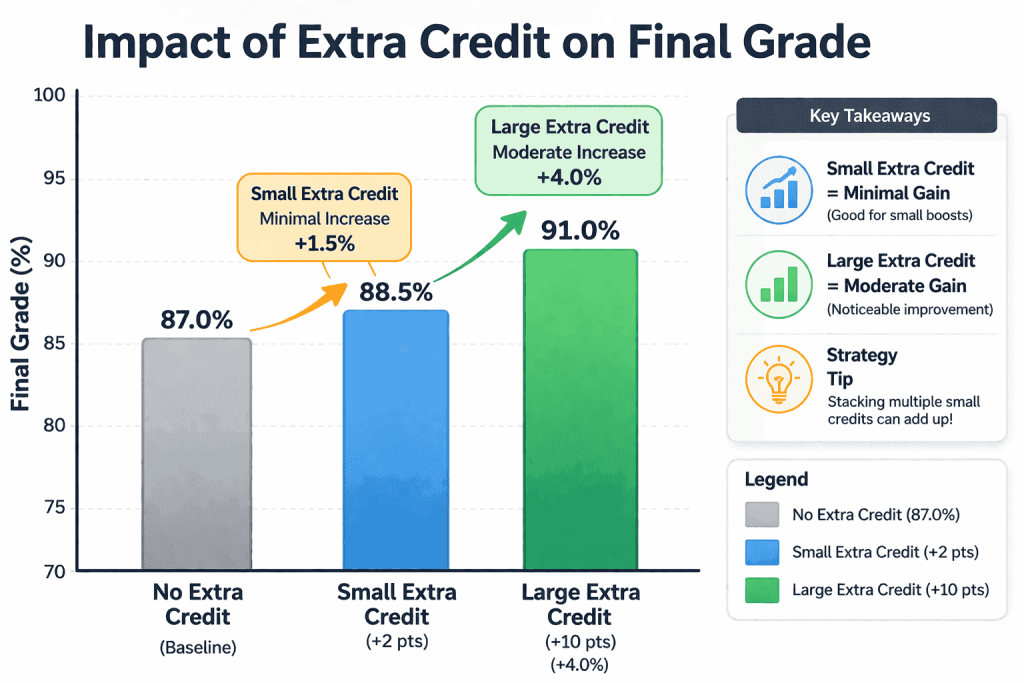
This is why many students ask, “how many extra credit points do I need to pass?” The answer depends entirely on your current standing and total points. If you’re far below a passing threshold, even large extra credit assignments won’t be enough.
In real-world usage, I often recommend running these scenarios through an extra credit grade calculator to visualize outcomes before committing time. For example, modeling different bonus values using an interactive extra credit grade calculator that simulates weighted and points-based systems across realistic classroom scenarios helps clarify exactly how many points you need and whether the effort is worth it—especially when deciding between multiple grade recovery strategies.
Weighted Grade Example: Why 5 Points May Change Less Than 1%
Now let’s look at a weighted grading system, which is even more restrictive. Imagine your grade breakdown is:
- Homework: 20% (current: 85%)
- Tests: 50% (current: 70%)
- Final Exam: 30% (pending)
Your current weighted grade:
- (0.2 × 85) + (0.5 × 70) = 17 + 35 = 52% so far
Now suppose you earn extra credit that increases your homework score by 5 points (from 85% to 90%).
New calculation:
- (0.2 × 90) + (0.5 × 70) = 18 + 35 = 53%
That’s only a 1% increase, even though you improved your homework performance significantly. This answers another common question: “how much difference does extra credit really make?”—in weighted systems, often very little.
The limitation comes from grade weighting categories. Since homework only counts for 20%, any improvement is scaled down. Meanwhile, tests (50%) dominate your final grade calculation, making them far more impactful.
High Impact Scenario: When Extra Credit Meaningfully Improves Grades
Despite these limitations, there are situations where extra credit can make a real difference. These are typically high-leverage scenarios, including:
- When you’re near a grade threshold (e.g., 69% to 70%)
- When extra credit applies to a high-weight category
- When your overall grade is already strong (marginal gains compound better)
For example, if your grade is 89% and extra credit pushes it to 90%, you’ve effectively jumped from a B to an A. That’s a small numerical change with a big academic impact, especially on your GPA (grade point average).
Another scenario involves cumulative grading near the end of a term. If your gradebook system allows extra credit to be applied globally rather than within a category, the effect can be amplified.
From experience analyzing academic policy variations, I’ve found that teachers who apply extra credit as bonus points to total scores (instead of category-limited boosts) offer students a much better opportunity for meaningful improvement.
How Much Extra Credit Raise Your Grade?
Key Factors: Grade Weights, Total Points, and Timing
The impact of extra credit isn’t random—it’s governed by a few critical variables. If you understand these, you can predict outcomes with surprising accuracy.
First is total points. The larger the total pool, the smaller the effect of each extra credit point. In a class with 2,000 total points, even 20 bonus points barely register. This is why extra credit percentage increase calculators are useful—they help quantify otherwise misleading assumptions.
Second is grade weights. In weighted vs unweighted grading systems, category importance determines influence. Extra credit applied to low-weight categories like participation or homework often produces negligible results, while boosts in exam categories can shift grades more noticeably.
Third is timing. Early in the term, extra credit has more room to influence your cumulative grade calculation. Later on, when most grades are locked in, its effect diminishes. This ties directly into grade recovery strategies—the earlier you act, the more options you have.
Why Extra Credit Impacts Low vs. High Grades Differently
One of the most overlooked aspects of extra credit is how it behaves differently depending on your current grade level. If you’re already performing well (say, 85%+), even small gains can push you into a higher letter grade. That’s marginal grade improvement working in your favor.
But if you’re struggling with a low grade (below 60%), extra credit becomes far less effective. Why? Because you’re fighting against a large deficit. Adding 10 or 20 points doesn’t significantly offset multiple low scores in major categories.
This leads to a common frustration: “can extra credit raise a failing grade?” Technically yes, but practically, it’s difficult without substantial bonus opportunities.
From reviewing performance evaluation data, I’ve noticed that students with lower grades benefit far more from improving core assessments than relying on extra credit. That’s because student effort vs grade outcome is not linear—some actions simply carry more weight than others.
Also learn: How to calculate final grade with credits?
Can Extra Credit Raise a Failing Grade?
Minimum Points Needed to Pass (Realistic Thresholds)
Let’s address this directly: can extra credit raise a failing grade? The honest answer is yes—but only under specific conditions, and usually not as easily as students hope.
Assume you have:
- Total points: 1,000
- Current points: 550
- Current grade: 55% (failing)
- Passing threshold: 60%
To pass, you need at least 600 points. That means you’re 50 points short.
If your teacher offers a 10-point extra credit assignment, completing it brings you to 560—not even close. Even five such assignments would be required just to reach passing, assuming they’re available and fully credited.
This highlights an important concept: grade thresholds (passing vs failing) create hard boundaries that small extra credit tasks rarely overcome.
When Extra Credit Fails to Recover a Grade
There are clear scenarios where extra credit simply doesn’t work as a recovery tool:
- When your deficit is too large
- When extra credit is capped or limited
- When it applies only to low-weight categories
- When it doesn’t replace low scores
This is why many educators emphasize academic fairness and grade inflation concerns. Extra credit is designed as a supplement—not a replacement for poor performance.
If you’re asking, “what is the fastest way to raise my grade?”, the answer is almost always the same: improve performance in high-impact assessments like tests, projects, or finals. Compared to that, extra credit is a secondary strategy.
Still, when used correctly—especially alongside other grade improvement strategies for students—it can provide that final push needed to cross an important academic milestone.
How Much Will Extra Credit Raise My Grade?
Step by Step Method to Estimate Grade Increase
If you’re still wondering, “how much will extra credit raise my grade?”, the most reliable way to answer that is by breaking it down into a simple, repeatable calculation. Guesswork leads to frustration, but once you understand the math behind final grade calculation, you can predict outcomes with surprising accuracy.
Start by identifying your current standing:
- Total points earned
- Total points possible
- Current grade percentage
Next, add your extra credit assignment points to your earned total. In most points-based grading systems, the denominator (total possible points) stays the same, which is why the increase is often smaller than expected.
For example:
- Current: 720 / 1,000 = 72%
- Extra credit: +15 points
- New: 735 / 1,000 = 73.5%
That’s a 1.5% increase, which answers a key question: “how many points to raise grade by 1 percent?” In this case, roughly 10 points equals 1%.
Now, if you’re working within a weighted grade formula, the process changes slightly. Instead of adding raw points, you adjust the category score where the extra credit applies. For instance, boosting a homework average from 80% to 90% in a 20% category only raises your overall grade by 2%.
This is why understanding extra credit points vs percentage grading is essential. The same assignment can produce very different outcomes depending on your scoring system.
One thing I’ve consistently observed while analyzing student data is this: those who calculate before acting make significantly better decisions. They know when extra credit is worth it—and when it’s not.
Using an Extra Credit Calculator to Predict Results Accurately
Manual calculations work, but they can get messy—especially when multiple categories, weights, and assignments are involved. That’s where a reliable extra credit grade calculator becomes a game-changer.
In practice, I’ve tested dozens of grading scenarios, and using a structured tool consistently produces more accurate predictions than mental math. For example, modeling scenarios using a dynamic extra credit grade calculator that allows you to input weighted categories, current scores, and bonus points while simulating real classroom gradebook systems with precise cumulative grade calculations and performance evaluation metrics makes it immediately clear how much impact each assignment will have.
This is particularly useful when comparing strategies. Instead of asking “how do I calculate my grade after extra credit?”, you can instantly visualize:
- Best-case vs worst-case outcomes
- Marginal gains from small assignments
- Whether you can realistically reach a target grade
It also helps answer deeper questions like:
- “Can extra credit boost my grade by a full letter?”
- “How many extra credit points do I need to pass?”
From a strategic standpoint, calculators remove emotional bias. They show the reality of student effort vs grade outcome, allowing you to focus on high-impact actions rather than low-return tasks.
Extra Credit vs. Test Retakes: What Helps More?
Point Recovery Comparison: Speed vs. Impact
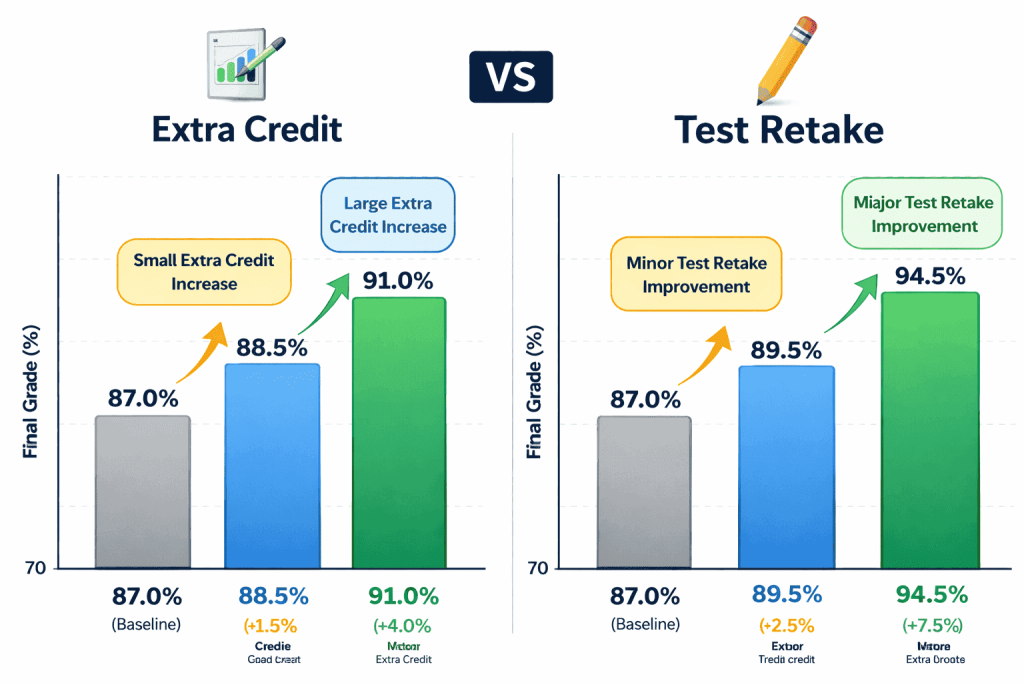
This is one of the most practical questions students face: extra credit vs test retakes—what helps more? The answer depends on what you value more—speed or impact.
Extra credit is usually faster. It’s often optional, shorter, and easier to complete. But its impact is limited because it typically adds bonus points rather than replacing poor performance.
Test retakes, on the other hand, are high effort but high reward. Improving a major exam score directly affects a heavily weighted category, which significantly boosts your final grade calculation.
Let’s compare:
| Strategy | Effort | Speed | Grade Impact |
|---|---|---|---|
| Extra Credit | Low–Medium | Fast | Low–Moderate |
| Test Retake | High | Slower | High |
In real academic scenarios, I’ve seen students gain 10–20% increases from retakes, compared to just 1–3% from extra credit. That’s because retakes affect core assessment categories, not just the margins.
So if you’re asking, “what is the fastest way to raise my grade?”, extra credit might feel like the answer. But if the goal is maximum improvement, retakes often win.
When Retakes Outperform Extra Credit?
Looking at performance evaluation trends across both high school and college systems, there’s a consistent pattern: grade replacement strategies outperform bonus-based strategies.
Why? Because of how grading methodology is structured.
- Extra credit = adds points
- Retakes = replaces low scores
This distinction is critical. If you scored 50% on a test worth 30% of your grade, improving it to 80% creates a massive shift. No realistic amount of extra credit can match that impact.
This also answers a common question: “can extra credit replace a low test score?” In most cases, no. That’s not how academic policy is designed.
From a strategic perspective, the best approach combines both:
- Use retakes to fix major weaknesses
- Use extra credit for marginal grade improvement near thresholds
That balance leads to the most effective academic performance improvement.
How Much Does Extra Credit Increase Your Grade in College vs. High School?
How Will Extra Credit Points Raise My Grade in High School?
High School: Typical Impact of Extra Credit Assignments
In high school settings, extra credit is more common and often more flexible. Teachers may offer bonus assignments, participation points, or even classroom activities that contribute to your overall score.
From my analysis of gradebook systems used in high schools, extra credit typically increases grades by:
- 1% to 5% in most cases
- Occasionally more if applied to total points instead of categories
This makes it especially useful for:
- Crossing grade thresholds (e.g., 89% to 90%)
- Improving GPA outcomes
- Supporting consistent student effort vs grade outcome
Another factor is flexibility. High school teachers are more likely to adjust grading scales or offer creative extra credit opportunities, making it a more viable grade recovery strategy.
How Much Does Extra Credit Increase Your Grade in College?
College: Limited Use and Lower Grade Influence
In college, the story changes significantly. Extra credit is less common, more restricted, and often carries less weight in the overall grading structure.
Professors tend to rely on:
- Major exams
- Research papers
- Final assessments
These dominate the weighted vs unweighted grading systems, leaving little room for bonus work. When extra credit is offered, it’s usually:
- Small in value
- Tied to specific assignments
- Limited by strict academic policy
As a result, how much does extra credit increase your grade in college is typically minimal—often less than 1–2%.
This shift reflects a broader focus on performance evaluation and maintaining academic fairness and grade inflation control. In other words, grades are meant to reflect mastery, not optional effort.
Teacher’s Guide to Setting Fair Extra Credit Policies
Preventing Grade Inflation While Rewarding Effort
From an educator’s perspective, extra credit presents a delicate balance. On one hand, it motivates students and rewards initiative. On the other, it can distort grading accuracy if not carefully designed.
Based on best practices and real classroom observations, effective extra credit policies should:
- Align with learning objectives
- Avoid replacing core assessments
- Maintain consistency across students
This ensures that extra credit enhances—not undermines—academic integrity.
One common mistake is offering excessive bonus points, which leads to grade inflation. When too many students rely on extra credit to boost grades, the grading scale (A, B, C, D, F) loses its meaning.
Structuring Extra Credit for Accurate Grade Representation
The most effective approach is to structure extra credit within existing assessment categories rather than outside them. For example:
- Bonus questions on exams
- Optional extensions tied to coursework
- Small percentage boosts within categories
This aligns with rubric-based grading and ensures that extra credit reflects actual learning.
Educators should also communicate clearly:
- How extra credit is calculated
- Where it applies in the grade weighting categories
- Its realistic impact on the final grade calculation
Transparency helps students make informed decisions and reduces misconceptions about how teachers calculate extra credit.
Conclusion: How Much Extra Credit Raise Your Grade?
So, how much does extra credit increase your grade? In most real-world scenarios, the answer is simple: not as much as you think—but enough to matter when used strategically.
Extra credit is best viewed as a precision tool, not a rescue plan. It works well for small adjustments, threshold crossings, and incremental gains. But when it comes to major grade recovery, strategies like test improvement and consistent performance carry far more weight.
If you approach it with the right expectations—and use tools like a grade calculator to guide your decisions—you can turn extra credit into a meaningful advantage instead of a missed opportunity.
Resources
- Classroom grading system documentation (Homeschool-Life Instructor Guide)
- Research on weighted grading systems – Journal of Educational Assessment
- Institutional grading policies from U.S. high schools and universities
- Teacher insights and academic evaluation frameworks from real classroom implementations
FAQs: Extra Credit & Grade Impact
How much will extra credit raise my grade?
Typically, extra credit increases your grade by 1% to 5%, depending on your scoring system, total points, and assessment categories. In large courses, even 25 points may only create a small percentage increase.
How much does extra credit increase your grade?
The extra credit impact on final grade is usually small because it adds bonus points vs grade replacement. It helps most when you are close to a grade boundary.
How much will 25 extra credit points raise my grade?
It depends on your total points. In a 1,000-point system, 25 points = ~2.5% increase. Use an extra credit percentage increase calculator designed for real classroom grading systems to estimate accurately based on your exact numbers.
Can extra credit raise a failing grade?
Yes, but only if enough points are available. Most grade thresholds (passing vs failing) require large improvements, and small extra credit tasks rarely close big gaps.
Is extra credit worth it for improving grades?
Yes. Marginal grade improvement near cutoffs like 69% to 70% or 89% to 90%. But for major recovery, improving exams is more effective.
Should I do extra credit or retake a test?
Prioritize retakes when possible. They follow a grade replacement strategy, which has a stronger effect than bonus points added through extra credit.
How do I calculate my grade after extra credit?
Add bonus points to your earned total, then divide by total points. For weighted classes, adjust category percentages. A course grade calculator by syllabus weights that accounts for weighted grade formula and cumulative grade calculation helps you get precise results without manual errors.
How to calculate extra credit into grade?
In points based grading, add extra points directly. In weighted grading, increase the relevant category. Teachers apply this based on grading methodology and rubric based grading policies.
How do teachers apply extra credit to grades?
Teachers typically apply it within assessment categories (homework, tests) or as total bonus points. This depends on academic policy, scoring system, and academic fairness and grade inflation controls.
What is the mean of grades with extra credits?
It’s your average after adding bonus points into the cumulative grade calculation, reflecting your updated academic performance.
How will extra credit points raise my grade in high school?
In high school, extra credit has more flexibility and may apply to total scores. That’s why how will extra credit points raise my grade in high school often results in slightly higher gains than college systems.
How much does extra credit increase your grade in college?
In college, extra credit usually has limited impact (often under 1–2%) because grading relies more on exams and strict performance evaluation standards.
Can extra credit lower your grade?
No. Extra credit only adds points. It cannot reduce your grade, but it may not significantly improve it if the total points pool is large.
Does extra credit count toward final exam?
Usually not. Most systems separate extra credit from final exams unless explicitly stated in the syllabus or grading methodology.
Does extra credit boost your GPA?
Extra credit boosts GPA only if it raises your final course grade to a higher letter grade. Small percentage changes typically don’t affect your grade point average (GPA).
Does extra credit affect CGPA?
Extra credit usually boosts your course grade but doesn’t directly change your cumulative GPA (CGPA) unless it raises the final grade recorded for the class. In that case, it can indirectly improve your CGPA by increasing the grade points earned.
Does an 89.5 round up to a 90?
It depends on the instructor’s policy. Some round based on grading scale rules, others don’t. Always check your syllabus.
How important is extra credit?
It’s useful for small gains but not a primary strategy. Real improvement comes from aligning student effort vs grade outcome with high-weight assignments.
How much does a 90 bring up your grade?
A 90% score helps most in high-weight categories like exams. In low-weight categories, the effect is smaller due to grade weighting categories.
What GPA is 70 credits?
Credits measure course completion, not GPA. A 70% grade usually equals a C (~2.0 GPA), but it varies by institution.
What is the fastest way to raise my grade?
Focus on high-impact areas first. For example, using a test score calculator that shows how improving exam performance changes your final grade faster than extra credit alone helps you choose the most effective strategy quickly and efficiently.

Olivia Grant is a former K–12 teacher (12 years) and Lead Content Strategist at EasyGraderHub, holding an M.Ed. in Curriculum & Instruction from the University of Washington. She writes EasyGraderHub’s grading guides and reviews its calculators for classroom accuracy. Read more about Olivia.