
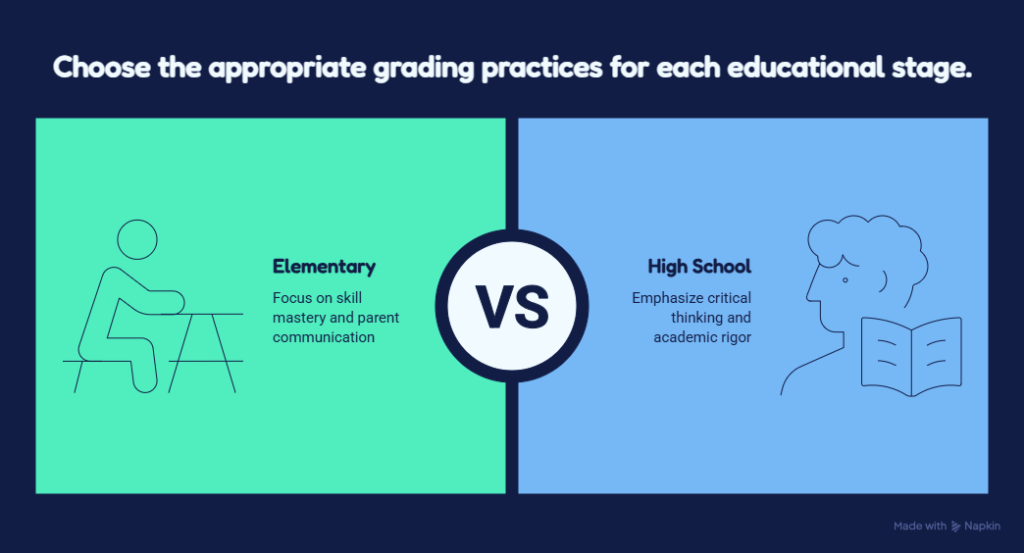
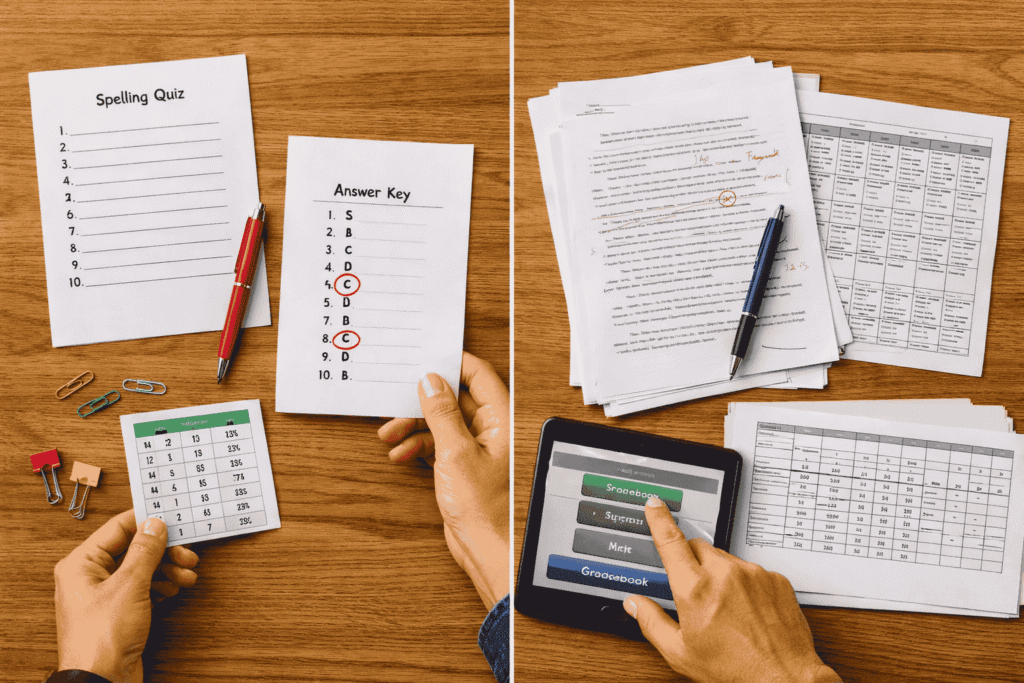
Grading looks very different in elementary school compared to high school. A second‑grade spelling quiz and a senior persuasive essay aren’t judged by the same standards, the assessment type, grading scale, depth of feedback, and time investment all shift dramatically.
Research by Guskey and Link (2019) highlights this divide: elementary teachers often see grades as a way to communicate progress to students and parents, while secondary teachers treat grades as measures of academic achievement, with exams carrying greater weight.
That difference in purpose reshapes everything, how long grading takes, which tools teachers rely on, and what a score truly represents. Recognizing these contrasts helps teachers streamline their work, parents interpret report cards more accurately, and students anticipate what grading will look like as they move through school.
These grading practices are part of the larger structure of how the US K-12 education system works, where each stage of schooling, elementary, middle, and high school shapes not only what students learn but also how their progress is measured.
Key Takeaways
- Elementary teachers (K-5) use answer keys, simple score charts, and standards-based levels. High school teachers (9-12) use rubrics, weighted categories, and multi-step scoring.
- Research by Guskey and Link (2019) found statistically significant differences in how elementary and secondary teachers weight assessment categories.
- The fastest grading method for objective tests at any grade level: pre-built answer key, digital calculator, one batch session.
- The Teacher Grader handles all score math automatically. A class of 30 papers takes under 10 minutes.
- The Easy Grader is the fastest single-score lookup for teachers, students, and parents.
How Do Elementary Teachers Grade Tests?
Short Tests, Simple Scoring
A typical K-5 quiz runs 10 to 20 questions. Most are objective: multiple choice, true/false, matching, fill-in-the-blank, or spelling. For these tests, the workflow is straightforward. The teacher uses a pre-built answer key, marks wrong answers, counts errors, and converts the score using a chart or calculator.
Guskey and Link (2019) found that elementary teachers lean more toward short quizzes, practice tests, and daily classwork when forming grades, compared to middle and high school teachers.
Standards-Based Scoring
Many elementary schools skip traditional letter grades entirely. They use a standards-based grading (SBG) system instead.
SBG reports student performance on specific learning skills using four levels: Emerging, Developing, Proficient, and Advanced. The teacher is not asking “how many did you get right?” They are asking “do you understand this skill?”
This means an elementary teacher may record no percentage at all. They mark each standard on a 1-4 scale and report by skill, not by overall score.
The Fastest Elementary Grading Workflow
For objective quizzes, no rubric is needed. An answer key and a grading calculator are enough.
The workflow:
- Build the answer key before handing out the test.
- Keep the key on your desk, not in a drawer.
- Circle wrong answers as you read each paper.
- Use a calculator to convert the wrong answer count to a score.
- Record the score immediately in the gradebook.
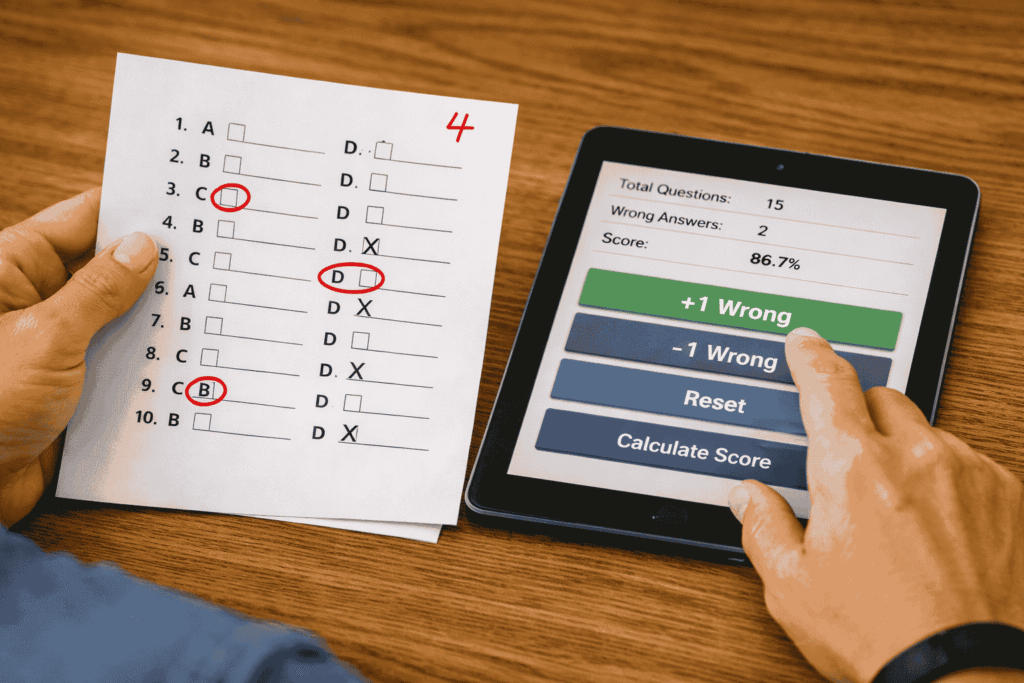
The Teacher Grader fits this workflow exactly. Enter the total questions once. Press +1 Wrong for each circled error. The percentage and letter grade appear instantly. Next Paper Mode keeps the question count locked so you never retype between papers. A class of 30 takes under 10 minutes.
Relevant Article: How to Score 30 Tests in Under 10 Minutes.
Brief Support Notes
Elementary teachers often add a short note to low-scoring papers: “Please review multiplication facts” or “We will revisit this next week.” These are parent signals, not detailed feedback. They take about 15 seconds per paper. Keep them short and keep them separate from the scoring step.
How Do High School Teachers Grade Tests?
More Complex Tests, More Steps
A high school biology exam might include 30 multiple-choice questions, 5 short-answer responses, and a data interpretation problem. Each section carries different point values.
Research shows that high school teachers attach more weight to summative assessments, projects, and homework than elementary teachers do (Guskey and Link, 2019). This means a high school teacher often cannot score the entire test in one pass. Objective sections use an answer key. Short-answer and essay sections need a rubric.
Why High School Tests Require Rubrics
A rubric is a scoring guide that lists specific criteria and describes what each performance level looks like. Without one, two teachers grading the same essay will assign different scores. That inconsistency is one of the most documented problems in K-12 grading research.
A well-built analytic rubric scores each criterion separately: thesis clarity, evidence quality, organization, grammar. This takes longer to set up but produces fair, defensible scores.
Rule: Build the rubric before the assignment goes out, not after the papers come in. Testing it on two or three sample papers before the live class catches scoring problems early.
Weighted Grades
High school classes often use weighted grading categories. A common setup:
| Category | Weight |
|---|---|
| Tests | 40% |
| Quizzes | 25% |
| Homework | 20% |
| Projects | 15% |
A student’s gradebook grade is a weighted average, not a simple average of raw scores. One high test score can offset several weak quiz scores. This is why parents sometimes see a gradebook percentage that does not match the score on a returned paper.
Essays and Multi-Step Problems
Essays are the biggest time cost in high school grading. Reading carefully, scoring across 4-6 rubric criteria, and writing feedback can take 5 to 12 minutes per paper. For 30 students, that is 2.5 to 6 hours for one assignment.
Multi-step math and science problems require checking each step for partial credit, not just the final answer. No automated tool replaces teacher judgment here. But handling objective sections with a digital grader first frees time and mental energy for the work that actually needs professional review.
Three Questions to Ask Before You Start Grading
These three questions take two minutes to answer. Skipping them costs far more.
1. What is the purpose of this test? Is it formative (what do students still need to learn?) or summative (final judgment of mastery)? Formative checks need fast turnaround. Summative grades need precision and documentation.
2. Does this need to be recorded in the gradebook? Exit tickets and low-stakes practice checks often exist for instructional data only. Knowing this upfront prevents spending 45 minutes grading work that only needed a quick scan.
3. What scoring format does the school require? Percentage grades, letter grades, or standards-based levels are not interchangeable. Grading policies vary widely by district, school, and class. Confirm the required format before paper one.
Which Grading Methods Save the Most Time?
For Objective Tests: Use a Digital Grading Calculator
For any test with one right answer per question, a digital calculator is always faster than mental math or a paper chart.
The formula is: (Correct Answers / Total Questions) x 100 = Score %
Doing this by hand for 30 papers takes roughly 90 minutes. Using the Teacher Grader’s +1 Wrong method takes under 10 minutes. The comparison is not close.
| Method | Per Paper | 30-Paper Total |
|---|---|---|
| Manual math, paper chart | ~3 min | ~90 min |
| Grade chart only | ~1.5 min | ~45 min |
| Teacher Grader + +1 Wrong | ~20-45 sec | ~10-22 min |
See comparison breakdown: Easy Grader vs Manual Grading
For Subjective Work: Use a Rubric Built Before the Assignment
Rubrics only save time if they exist before grading starts. A rubric built mid-stack forces real-time scoring decisions that slow everything down and introduce inconsistency.
One practical rule: if a rubric is hard to apply consistently on two sample papers, rewrite it before grading the rest.
Grade by Question Type, Not by Student
For mixed-format tests, complete all objective questions across the full class stack first. Then switch to the rubric for short-answer or essay sections across all papers.
This is called question-type batching. It removes the mental cost of switching between two completely different scoring modes on every single paper.
Common Mistakes That Slow Teachers Down
1. Starting without a scoring plan. No answer key, no confirmed grading scale, no rubric ready. The teacher makes these decisions in real time, once per paper instead of once per session. This alone can double grading time.
2. Mixing score entry with written feedback. These are two separate tasks. Scoring a paper and writing a comment are cognitively different. Blending them turns a 10-minute objective session into a 45-minute feedback session. Score all papers first. Record scores. Return to feedback separately.
3. Correcting things the test was not designed to measure. Spelling errors on a math quiz belong in the English grade, not the math grade. Marking and noting them pulls grading time away from the actual assessment purpose.
Grading often feels like it takes forever, but it doesn’t have to. With the right workflow, teachers can cut grading time in half without sacrificing accuracy. By streamlining repetitive steps, locking in question counts, and automating calculations, you move from hours of work to minutes per class. These practical shortcuts are exactly what make grading manageable and sustainable.
How to Build a Faster Grading Workflow
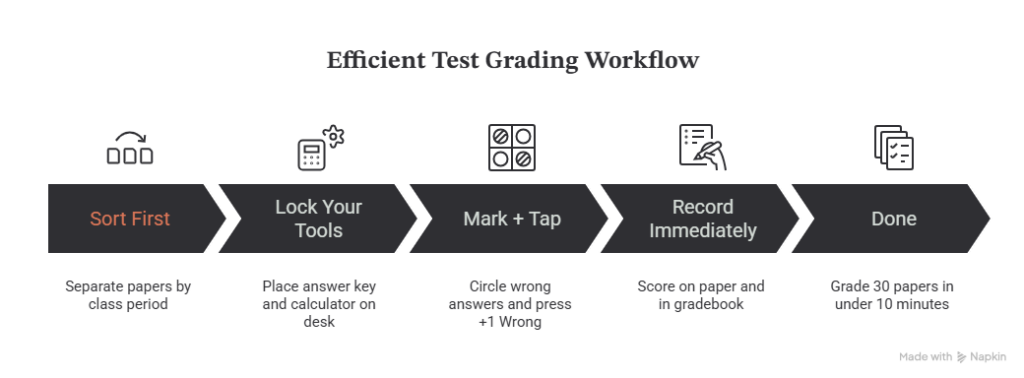
Step 1: Sort Before You Start
Separate papers by class period before touching the first one. For mixed-format tests, decide now whether you will grade sections in separate passes. Sorting takes two minutes and prevents re-handling papers later.
Step 2: Lock Your Tools First
Before paper one, confirm: answer key is on the desk, grading scale is set, session type is clear. Open the Teacher Grader, enter total questions, enable Next Paper Mode. Everything ready before you pick up the first paper.
Step 3: Batch by Question Type
Objective section first, across every paper. Subjective section second, across every paper. Never alternate between modes mid-stack.
Step 4: Record Immediately
Write the score on the paper and in the gradebook in the same motion. Do not create a “record later” pile. Deferred recording creates a second session and introduces transcription errors.
Step 5: Single Lookups Go to the Easy Grader
After papers are returned, parents or students sometimes question a score. Use the Easy Grader to verify any score in seconds. Enter the number correct and the total. The percentage and letter grade appear instantly.
Also read: How to Grade 100+ Students without Burnout
Why Grading Differs by Grade Level
Student Age Changes the Stakes
A third-grader missing half a reading quiz signals a comprehension gap the teacher fixes in the next lesson. A high school junior missing half a unit exam raises questions about preparation, prior knowledge, and course readiness.
The scoring process is similar. The instructional response to the score is completely different.
Elementary: Communication First
Elementary grades are primarily informational. They tell parents and students where a child stands on specific skills. Scores often carry written notes, not just numbers.
This is appropriate for the developmental stage. It also adds time per paper. Keep support notes short and consistent.
High School: Precision Required
High school grades affect GPA, class rank, college admissions, and scholarship decisions. Research shows grading inconsistency at the high school level has direct consequences for students’ access to college and scholarships (Guskey and Link, 2019).
A teacher cannot grade 30 papers on Tuesday with one rubric interpretation and 30 more on Friday with a slightly different one. Precision matters well beyond the individual classroom.
What Parents and Students Should Know
The Same Score Can Mean Different Things
A 78% in third grade may reflect proficiency across several skills on a standards-based scale. A 78% in an AP class reflects a weighted average across multiple assessment categories. The number looks the same. The system behind it is completely different.
How to Ask the Right Question
Parents and students have the right to know how any test was scored. The most useful question is: “What is the grading scale for this class?” or “How are the sections of this test weighted?”
Most teachers are happy to explain. Most grade disputes start because nobody asked.
Before Assuming a Grade is Wrong
Check three things before raising a concern with a teacher:
- Was the correct total question count used? A data entry error shifts a grade by a full letter.
- For essay or short-answer sections, compare the rubric to the score directly.
- Is this the raw paper score or the weighted gradebook score? They can differ significantly.
To verify any score yourself, use the Easy Grader. Enter the score earned and total questions. If the calculated percentage does not match what the teacher recorded, you have a specific, concrete question to bring to the conversation.
Conclusion:
Grading fast does not mean grading carelessly. It means removing every step that was never part of grading to begin with: math, chart-searching, re-reading the answer key, and transcription delays.
Teachers who grade fastest share two habits: they have a scoring plan before paper one, and they use a grading calculator for every objective test. Both habits take five minutes to set up. They save hours every week. For objective tests at any grade level, start with the Teacher Grader. For any single score check, use the Easy Grader.
FAQs:
How do teachers grade tests in elementary school?
Elementary teachers use objective tests with a pre-built answer key. They mark wrong answers, count them, and convert to a percentage or standards-based level using a chart or calculator. Many schools report on a 1-4 skill scale instead of A-F.
How do teachers grade tests in high school?
High school teachers use a combination. Objective sections use an answer key. Essay and short-answer sections use a rubric. Most classes also apply weighted grading, where tests, quizzes, and projects each count for a set percentage of the final grade.
Why do two teachers grade the same test differently?
Grading practices vary by teacher. Without a shared rubric and grading scale, two teachers scoring the same student work will assign different scores. This is one of the most documented consistency problems in K-12 education research.
What is the fastest way to grade objective tests?
Pre-build the answer key. Use the Teacher Grader with the +1 Wrong method. Grade all papers in one batch session. A class of 30 papers on a 20-question quiz takes under 10 minutes.
What is standards-based grading?
Standards-based grading reports performance on specific learning skills using proficiency levels instead of percentage scores. It is most common in K-5. It tells parents which skills a student has mastered, not just how many questions they got right.
What is a grading rubric and when is it needed?
A rubric is a scoring guide listing specific criteria and performance levels for each. Teachers use rubrics for essays, projects, and lab reports where there is no single right answer. Build the rubric before the assignment goes out, not after papers arrive.
Can parents check a test grade themselves?
Yes. Use the Easy Grader. Enter the number of questions and the number answered correctly. The percentage, letter grade, and pass/fail status appear instantly. No account needed.
What does weighted grading mean for a student’s final grade?
Each assignment category (tests, quizzes, homework, projects) counts for a set percentage of the final grade. A student’s gradebook grade is a weighted average across those categories, not a simple average of all raw scores.

Olivia Grant is a former K–12 teacher (12 years) and Lead Content Strategist at EasyGraderHub, holding an M.Ed. in Curriculum & Instruction from the University of Washington. She writes EasyGraderHub’s grading guides and reviews its calculators for classroom accuracy. Read more about Olivia.