7 Simple Steps to Calculate High School GPA (2026 Guide)

how to calculate high school gpa

Your junior year report card arrives. You scan it. Three A’s, two B’s. But the one number your parents, your counselor, and every college application is actually going to ask about isn’t anywhere on that page.

Most students don’t calculate their own GPA until they’re filling out a college application and by then, one semester of weak grades three years ago is already baked into the number. That’s the part nobody tells you early enough.

Here’s the reality: calculating your high school GPA is a 10-minute process once you understand the formula. And understanding it early like, freshman-year early changes the decisions you make about which classes to take, when to push harder, and when a single tough grade actually matters less than you think.

This guide walks you through exactly how to calculate your GPA in 7 steps, with a real worked example. We cover both weighted and unweighted systems, the most common calculation mistakes (one of them costs students a full GPA point they didn’t know they lost), and what your number actually needs to look like for different college and scholarship targets.

By the end, you’ll have your current GPA and you’ll know exactly what it would take to move it.

Key Takeaways

  • GPA converts letter grades (A, B, C) into numbers on a 4.0 or 5.0 scale
  • Weighted GPA rewards AP, Honors, and IB courses with extra points
  • You need your transcript showing final grades and credit hours to calculate accurately
  • The formula: Total Quality Points ÷ Total Credits = Your GPA
  • Most merit scholarships require 3.0+ GPA; competitive colleges prefer 3.5+
  • Common mistakes include mixing weighted/unweighted scales or counting non-academic classes
  • Calculate your GPA each semester to track progress and identify improvement opportunities

What is GPA?

Grade point average (GPA) is the single number that summarizes your entire academic performance. Schools calculate GPA by converting letter grades into numerical values, then averaging them across all your courses.

Understanding GPA matters because it’s the first filter colleges use when reviewing applications. A strong grade point average opens doors to competitive universities, merit scholarships, and academic honors programs. Parents and students need to track this number starting freshman year—not just senior year when college applications are due.

GPA = Your Grades as One Number

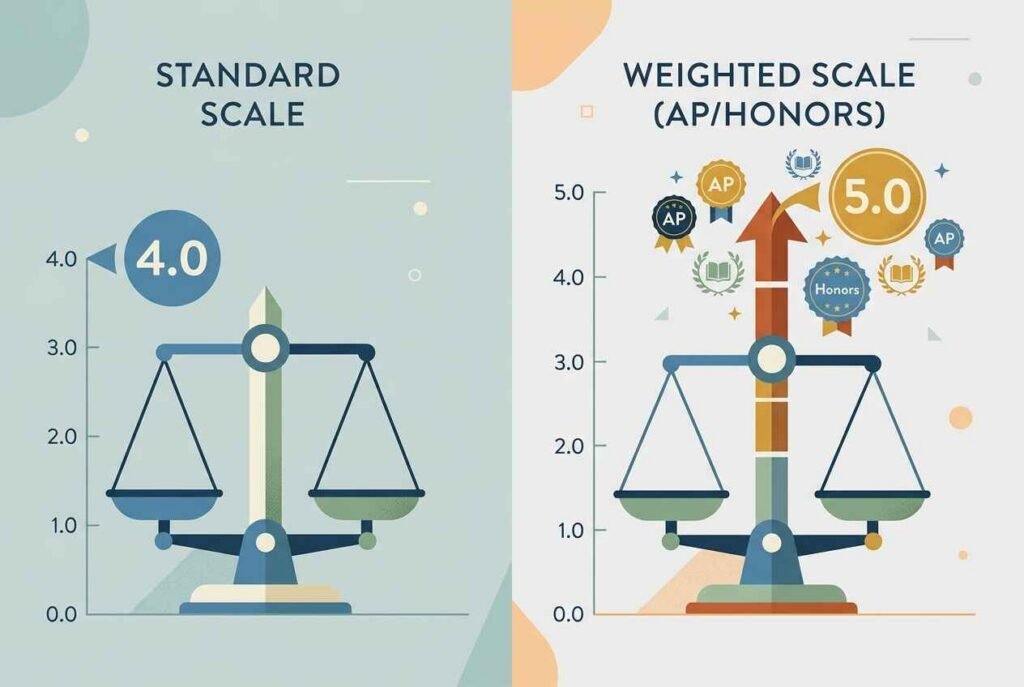
Grade Point Average converts your letter grades into a standardized numerical scale. An A becomes 4.0, a B becomes 3.0, a C becomes 2.0, and so on down the grading scale.

This number appears on your high school transcript as a single value between 0.0 and 4.0 for unweighted GPA. If your school uses weighted GPA to reward challenging coursework, the scale extends to 5.0 or higher for AP and Honors classes.

Here’s the basic conversion every student should memorize:

  • A = 4.0 grade points
  • B = 3.0 grade points
  • C = 2.0 grade points
  • D = 1.0 grade points
  • F = 0.0 grade points

Your transcript combines all these letter grades into one GPA number that colleges, scholarship committees, and honor societies use to evaluate academic achievement. Think of it as your academic credit score—higher numbers create more opportunities.

If you are wondering how to know your GPA in high school before your official transcript arrives, following the steps in this guide will give you an exact number.

Why GPA Matters?

College admission offices receive thousands of applications each year. Your GPA provides the quickest way for admissions counselors to assess whether you meet their academic standards before reviewing essays or activities.

Scholarship eligibility depends heavily on maintaining specific GPA thresholds. Most merit-based scholarships require a minimum of 3.0, while competitive awards often demand 3.5 or higher. Even small GPA differences can mean thousands of dollars in scholarship funding.

Honor roll recognition at your high school typically requires maintaining a certain grade point average each semester. These academic achievements strengthen college applications and demonstrate consistent performance over time.

The bottom line? Higher GPA equals more opportunities—better college options, more scholarship money, and recognition for academic success. Students who understand how to calculate high school GPA can set realistic targets and track their progress toward those goals each semester. Students who master calculating high school GPA can set realistic targets and track their progress toward those goals each semester.

One thing most guides skip: your GPA means different things to different audiences. To your high school, it’s the number that determines honor roll and class rank. To a college admissions office, it’s one data point they’ll recalculate on their own internal scale anyway. Many selective schools “reweight” submitted GPAs to remove the extra points for AP courses before comparing applicants. To a scholarship committee, it’s a pass/fail threshold. Knowing which version of your GPA is being evaluated and by whom, matters more than the raw number itself.

Understanding the Two GPA Scales

Most high schools calculate GPA using either a 4.0 unweighted scale or a 5.0 weighted scale. Some schools report both numbers on transcripts, which creates confusion for students and parents reviewing academic records.

The difference between weighted and unweighted GPA affects how colleges evaluate your academic rigor. Understanding both systems helps you accurately calculate your grade point average and know which number to report on applications.

4.0 Scale (Unweighted GPA)

The standard 4.0 scale treats all classes equally regardless of difficulty level. Whether you earn an A in regular English or AP English, both count as 4.0 on the unweighted scale.

This is the most common grading system used by American high schools. Every A you earn translates to 4.0 grade points, every B becomes 3.0, and the pattern continues through the entire grading scale.

Here’s how the unweighted GPA scale works:

Letter GradePercentageGPA Points
A90-100%4
B80-89%3
C70-79%2
D60-69%1
FBelow 60%0

All your academic classes carry the same weight in the calculation. An A in Honors Chemistry counts the same as an A in regular Chemistry when schools use this standard scale. The maximum unweighted GPA you can earn is 4.0, achieved by getting straight A’s in all courses.

Relevant:

5.0 Scale (Weighted GPA)

Weighted GPA rewards students who challenge themselves with AP classes, Honors courses, and IB programs. This system adds extra points to recognize the increased difficulty of advanced coursework.

The boost you receive depends on your school’s specific weighting policy. Most schools add 0.5 points for Honors classes and 1.0 point for AP or IB courses, but these values can vary by district.

Here’s a typical weighted scale breakdown:

Letter GradeRegular Course (4.0 Scale)Honors Course (4.5 Scale)AP/IB/Dual Enrollment (5.0 Scale)
A (90–100%)44.55
B (80–89%)33.54
C (70–79%)22.53
D (60–69%)11.52
F (<60%)000

Only your advanced courses get the extra points—regular classes still use the 4.0 scale even in weighted GPA calculations. This means your weighted GPA can exceed 4.0, sometimes reaching 4.5 or even 5.0 if you take multiple AP classes.

Plus/Minus Grades (If Your School Uses Them)

Some schools add precision to grading by using A+, A, A-, B+, and similar variations. These plus/minus designations create more granular GPA calculations.

A common plus/minus scale assigns A=4.0, A-=3.7, B+=3.3, and B=3.0. However, these exact point values differ by school—some districts count A+ as 4.3 while others keep it at 4.0.

A critical reality check: not all colleges take your weighted GPA at face value. Many highly selective universities — including the entire UC system and recalculate applicants’ GPAs using their own methodology, stripping out weighting adjustments and recapping at 8 semesters of 10th–11th grade courses. The UC’s published GPA recalculation methodology. Know both your weighted and unweighted GPA, because different institutions will use different versions of your number.

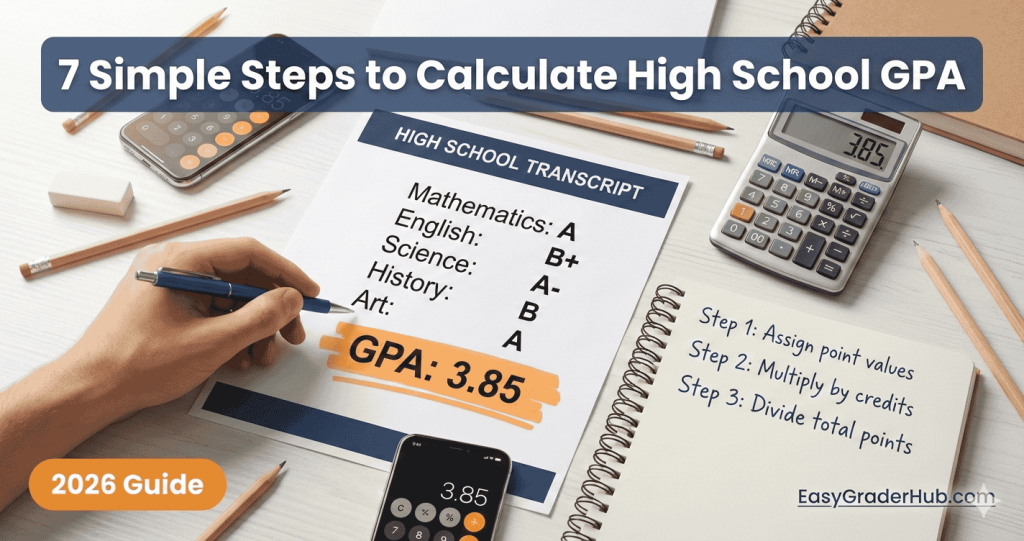
7 Steps for How to Calculate High School GPA (With Real Example)

Follow these 7 steps with our example student, Alex, a junior with 5 classes. Grab your transcript and calculate along—you’ll have your GPA in less than 10 minutes.

Alex’s transcript for fall semester shows:

  • AP English: A (1.0 credit)
  • Honors Math: B+ (1.0 credit)
  • Chemistry: A- (1.0 credit)
  • History: B (1.0 credit)
  • Spanish: A (1.0 credit)

Step 1: List All Your Final Grades

Get your transcript or final report card showing end-of-semester grades. You need the final course grades—not individual test scores or quarter grades unless that’s how your school calculates GPA.

Include all academic classes: math, English, science, social studies, and foreign languages. These core courses plus academic electives count toward your grade point average.

Exclude non-academic classes like PE, study hall, lunch credit, or teacher aide positions. Most schools don’t count these in GPA calculations, though policies vary by district. When in doubt, check your official transcript to see which courses appear in your school’s GPA calculation.

Step 2: Convert Grades to Points

Use the grading scale from your school to convert each letter grade into its numerical point value. Alex attends a school that weights AP and Honors courses, so we’ll use the weighted scale.

Alex’s conversions look like this:

  • AP English A = 5.0 (AP course gets 1.0 bonus)
  • Honors Math B+ = 4.3 (Honors gets 0.5 bonus, plus +0.3 for the plus)
  • Chemistry A- = 3.7 (regular course, minus grade)
  • History B = 3.0 (regular course)
  • Spanish A = 4.0 (regular course)

Make sure you’re consistent—if calculating weighted GPA, apply the weight to all applicable courses. For unweighted calculation, all A’s become 4.0 regardless of course difficulty.

Step 3: Check Credit Hours

Most semester-long high school classes carry 1.0 credit hour. Half-year courses typically earn 0.5 credit, while some lab sciences might count as 1.5 credits due to additional lab time.

Check your transcript for exact credit values—don’t assume. Your official transcript lists the credit hours next to each course, and these numbers determine how much weight each class carries in your final GPA.

Alex’s courses are all full-semester classes worth 1.0 credit each. This makes the calculation straightforward, but students with varied credit hours need to pay close attention in the next steps.

Step 4: Calculate Quality Points

Quality points show the weighted value of each course. The formula is simple: multiply each course’s grade points by its credit hours.

Here’s Alex’s quality points calculation:

  • AP English: 5.0 × 1.0 = 5.0 quality points
  • Honors Math: 4.3 × 1.0 = 4.3 quality points
  • Chemistry: 3.7 × 1.0 = 3.7 quality points
  • History: 3.0 × 1.0 = 3.0 quality points
  • Spanish: 4.0 × 1.0 = 4.0 quality points

This step accounts for courses that carry different credit values. A 0.5-credit class has half the impact on your GPA compared to a 1.0-credit class, which this calculation reflects.

Teachers and counselors sometimes call these “grade points” instead of quality points, but they mean the same thing. You’ll use this total in the final GPA calculation.

Step 5: Add Total Quality Points

Add up all the quality points you calculated in Step 4. This gives you the total grade points earned across all your courses.

Alex’s total: 5.0 + 4.3 + 3.7 + 3.0 + 4.0 = 20.0 total quality points

Double-check your addition here. A simple math error in this step throws off your entire GPA calculation, and you won’t know the result is wrong unless the number seems unusually high or low.

Step 6: Add Total Credits

Add up all the credit hours from your courses. This total shows how many credits you’re dividing by in the final step.

Alex’s total: 1.0 + 1.0 + 1.0 + 1.0 + 1.0 = 5.0 total credits

Most students taking 5 or 6 semester courses will have 5.0 to 6.0 total credits. If you have half-credit courses or dropped a class mid-semester, your total will be different.

Step 7: Divide for Your GPA

This is the final calculation that gives you your actual grade point average. Divide your total quality points by your total credit hours.

Formula: Total Quality Points ÷ Total Credits = GPA

Alex’s GPA: 20.0 ÷ 5.0 = 4.0 GPA

Round your result to two decimal places for accuracy. Alex earned a perfect 4.0 weighted GPA this semester—excellent work taking challenging courses and performing well.

Quick Calculation Summary:

  • Total Quality Points: 20.0
  • Total Credits: 5.0
  • Final GPA: 4.0

This same process works for calculating cumulative GPA over multiple semesters. Just include all semesters’ courses in steps 1-6 before dividing. Want to double-check your work or run the numbers on a hypothetical schedule? Our grade calculator tools handle weighted and unweighted calculations instantly useful for both current GPA and end-of-semester projections.

What if your school uses a block schedule or trimester system?

The same 7 steps apply, but your credit hour values may look different. Block schedule students often earn 1.0 credit per semester in courses that meet daily, just as in a traditional schedule. Trimester students typically earn 0.67 credits per course (three terms × 0.67 = roughly 2.0 credits per year-long subject). Always pull the exact credit values from your official transcript rather than estimating a difference of 0.5 credits per course can shift your cumulative GPA by 0.1 to 0.2 points over four years.

Cumulative GPA: All 4 Years Combined

Your semester GPA shows performance for one term, but colleges care more about cumulative GPA—the average of all your high school semesters combined. Understanding both numbers helps you track progress and set realistic improvement goals.

Semester vs Cumulative GPA

Semester GPA calculates performance for a single term using only that term’s courses. Alex’s 4.0 from the example above represents one semester’s work, not an entire high school career.

Cumulative GPA includes every course from 9th grade through your current semester. This overall GPA appears on your official transcript and is what colleges review during admissions.

Track your semester GPA each term to monitor trends. A strong semester GPA indicates you’re on the right track, while a declining semester GPA signals you need to adjust study habits before it significantly impacts your cumulative number.

How to Calculate 4-Year GPA

Use the same 7 steps you just learned, but include courses from all semesters instead of just one term. This means listing final grades from freshman year through your current semester.

Here’s a quick example of a student completing 8 semesters:

  • Add quality points from every single course across all 4 years
  • Add total credits earned (usually 30-40 credits for 4 years)
  • Divide total quality points by total credits for cumulative GPA

Each year affects your cumulative GPA differently due to the growing denominator. Freshman year represents roughly 25% of your four-year GPA. By junior year, one semester only moves your cumulative GPA by about 12-15% because you have so many previous credits in the calculation.

This is the math most freshmen don’t understand until it’s too late to act on it. Say you finish 9th grade with a 2.5 GPA across 6 credits. By the time you’ve added 18 more credits through junior year, that 2.5 is still dragging your 24-credit cumulative average down by roughly 0.2 to 0.3 GPA points — even if you’ve gotten straight A’s since. Recovery is possible. But it requires sustained above-average performance for multiple semesters, not just one good quarter. Tracking your GPA from freshman year builds a stronger academic record than waiting until junior year when applications are near. It’s the single most powerful habit a high school student can adopt to maximize college opportunities.

If you’re a teacher calculating class averages or tracking student progress throughout the semester, Class Grader helps you quickly see how individual assignments and tests contribute to final course grades. This same principle of weighted averaging applies whether you’re calculating a student’s course grade or their overall GPA.

Free High School GPA Calculator

Skip the manual calculation and get instant results with our free online GPA calculator. This tool handles weighted and unweighted calculations, plus/minus grading, and varied credit hours automatically.

5 Common GPA Mistakes and Quick Fixes

Even students who understand the calculation process make errors that throw off their results. Avoiding these common mistakes ensures your calculated GPA matches your official transcript.

Mistake #1: Wrong Classes Included

Students often include PE, study hall, lunch credit, or teacher aide positions in GPA calculations. Most schools exclude these non-academic courses from grade point average calculations.

Only count core academic classes and academic electives. Math, English, science, social studies, and foreign languages definitely count. Art, music, and computer science typically count as academic electives.

When you’re unsure whether a class counts, check your official transcript. Schools list GPA-eligible courses separately or mark which courses factor into the calculation. Your guidance counselor can clarify your specific school’s policy if the transcript doesn’t make it obvious.

Mistake #2: Mixing Weighted/Unweighted

Calculating weighted GPA for some courses while using unweighted values for others creates inaccurate results. You must choose one system and apply it consistently across all classes.

For weighted calculations, use 4.5 or 5.0 point values for AP and Honors courses as your school defines them. For unweighted calculations, all A grades equal 4.0 regardless of course difficulty.

Many students accidentally use 5.0 for their AP English A but forget to weight their Honors Math B+. This inconsistency artificially deflates the final GPA number. Pick your system before starting step 2 and stick with it through step 7.

This is especially common when students manually calculate GPA from memory rather than transcript. If you’re uncertain which system your school uses, the GPA printed on your official transcript is always the authoritative number. Your manually calculated result should match it within 0.05 points. A larger gap usually signals a weighting inconsistency.

Mistake #3: Wrong Credit Values

Assuming all courses carry 1.0 credit leads to calculation errors when you have half-year classes or courses with lab components. Your transcript shows exact credit values—use those numbers, not assumptions.

Half-year courses typically earn 0.5 credit hours. Some lab sciences award 1.5 credits due to additional lab time beyond regular class meetings. A few schools use quarter credits (0.25) for very short courses.

Check every course’s credit value on your transcript before multiplying in step 4. This small detail significantly impacts your quality points total when you have multiple courses with non-standard credits.

Mistake #4: Bad Math

The most frustrating error is simple arithmetic—adding wrong, multiplying incorrectly, or dividing by the wrong number. Students sometimes divide total quality points by the number of classes instead of total credit hours.

Always divide by your total credits, not your course count. Five courses worth 1.0 credit each means dividing by 5.0 credits. But five courses with mixed credits (three at 1.0, two at 0.5) means dividing by 4.0 credits total.

Use a calculator for steps 4-7 to avoid basic math errors. Double-check your work by recalculating once—catching mistakes before submitting college applications prevents embarrassing discrepancies between your calculated GPA and official transcript.

Mistake #5: Ignoring Retaken Classes

When you retake a failed course or repeat a class for grade improvement, most schools replace the original grade in GPA calculations. Some schools average both attempts instead of replacing, which significantly changes the result.

Check your school’s grade replacement policy before calculating. Your transcript shows which grade counts—if you see both attempts listed but only one factored into GPA, your school uses replacement. If both grades appear in the GPA column, your school averages them.

This policy matters enormously for students who failed a course freshman year but earned an A when retaking it. Grade replacement gives you the A only, while averaging gives you somewhere between F and A depending on the specific grades.

What GPA Do You Need?

Different colleges and scholarships set different GPA requirements. Knowing these benchmarks helps you set realistic targets and understand where you stand competitively.

Here’s what you need by college type:

College TierTypical Unweighted GPA (Admitted)Notes
Ivy League & Equivalent3.9–4.0Harvard Class of 2027 avg: 4.18 weighted
Top 20–50 Universities3.7–3.9UC Berkeley: 89.2% of admits had 3.75+
Competitive State Schools3.5–3.7Wide variation by major and state residency
Average 4-Year State Schools3.0–3.5National average HS GPA is ~3.0 unweighted
Community College2.0+Most are open-enrollment

PrepScholar College GPA Requirements: how college GPA requirements work in practice for different selectivity tiers


These figures come from published Common Data Sets and university admissions pages, not estimates. But there’s an important nuance: most selective colleges recalculate your GPA using their own methodology when reviewing your application. The number they use may differ from what’s on your transcript.

GPA matters differently at each grade level. Freshman year, aim for 3.5 or higher to build a strong foundation. Sophomore year, maintain or improve that baseline to reach 3.6 or better. Junior year is most critical for college applications—target 3.7 or higher if you’re aiming for competitive schools.

Senior year requires maintaining your GPA through graduation even after college acceptances arrive. Many schools revoke admission offers if GPA drops significantly during senior year, and scholarship eligibility often depends on maintaining specific thresholds.

For scholarship eligibility, understand these general ranges:

  • Merit scholarships usually require 3.0+ minimum
  • Competitive scholarship programs prefer 3.5+
  • Full-ride scholarships often demand 3.8-4.0

Your specific scholarship requirements vary by program, so check individual eligibility criteria. Even small GPA differences—like 3.4 versus 3.5—can determine qualification for thousands of dollars in awards. Many students find that understanding how individual assignment grades affect their course performance helps them make strategic decisions about where to focus study time.

Conclusion

You now have the 7 steps, the worked example, the common mistakes, and the benchmarks. Here’s the one thing worth repeating before you close this tab: the students who manage their GPA best aren’t necessarily the ones who study the hardest. They’re the ones who track the number early enough to act on it before a single rough semester gets compounded across three more years of credits.

Calculate your current GPA today using the steps above or the GPA calculator. Set a specific target for next semester based on the college or scholarship benchmarks in this guide. Then check back after your final exams. The formula doesn’t change. Your results can.

Frequently Asked Questions

how to know your GPA in high school?

The easiest way to know your current GPA is to use an online calculator like ours or to manually convert your letter grades to points using a standard 4.0 scale and averaging them.

Can my GPA go above 4.0?

Yes, weighted GPA can exceed 4.0 when you take AP, Honors, or IB courses. Unweighted GPA maxes out at 4.0 regardless of course difficulty. Schools using weighted scales typically see GPAs ranging from 4.0 to 5.0 for students taking multiple advanced courses.

Do colleges see weighted or unweighted GPA?

Your transcript shows both weighted and unweighted GPA in most cases. Colleges see whichever numbers your school reports, then many recalculate using their own formulas. Report both when college applications ask—transparency about your academic record is always best.

How often should I calculate my GPA?

Calculate at the end of each semester as a minimum. Students applying to colleges should calculate before submitting applications to ensure accuracy. Calculate whenever you’re making course selection decisions or tracking progress toward specific GPA goals.

Does freshman year count toward my GPA?

Yes, freshman year grades are included in your cumulative GPA. Some colleges give freshman year less weight during admissions review, but the grades still factor into your four-year average. A strong freshman year makes maintaining high cumulative numbers much easier.

What if my school doesn’t weight GPA?

Report your unweighted GPA on applications. Your transcript will still show the rigor of courses you took even without weighted points. Colleges see that you challenged yourself with AP or Honors classes regardless of whether your school weights them numerically.

How do I calculate GPA with different credit hours?

Follow step 4 exactly—multiply each course’s grade points by its specific credit value. A 0.5-credit course contributes half the quality points of a 1.0-credit course. The weighted calculation automatically accounts for varied credit hours when you multiply before dividing.

Do elective courses count toward GPA?

Academic electives like foreign languages, art, music, and computer science usually count. Non-academic classes like PE, study hall, and teacher aide typically don’t count. Check your school’s specific policy by reviewing which courses appear in your transcript’s GPA calculation.

How does retaking a class affect my GPA?

Most schools replace the original grade with your new grade in GPA calculations. Some schools average both attempts instead. Your transcript shows the policy—if both grades appear but only one counts toward GPA, your school uses replacement.

Is a 3.5 GPA good?

A 3.5 GPA is above the national average of approximately 3.0 and competitive for many state universities. You’ll qualify for numerous merit scholarships at this level. Top-tier schools typically expect higher, around 3.7-4.0, but 3.5 opens many solid college options.

Can summer school classes improve my GPA?

Yes, if summer courses appear on your official high school transcript. Taking summer classes is a strategic way to retake failed courses for grade replacement or earn additional A’s to boost your cumulative average.

Why doesn’t my calculation match my transcript?

Schools may weight courses differently than you assumed, include or exclude different classes, or use rounding rules you didn’t apply. Always use your official transcript GPA for college applications rather than your own calculation. Calculate mainly to understand the process and track semester progress.

Do colleges recalculate my GPA?

Most selective colleges recalculate using their own formulas. They often count only core academic classes, remove weighted points, or apply their own weighting system. This standardization helps them compare applicants from different high schools fairly.

What GPA do I need for scholarships?

Merit scholarships typically require 3.0 minimum. Competitive scholarship programs prefer 3.5 or higher. Full-ride scholarships often demand 3.8-4.0. Check each scholarship’s specific requirements since they vary significantly by program and institution.

Is it too late to improve my GPA senior year?

No, first semester senior year grades still matter. Colleges see mid-year reports showing fall semester performance. Even small improvements help, and maintaining a strong GPA through graduation prevents acceptance rescissions.

What’s the difference between academic and overall GPA?

Academic GPA includes only core classes—math, English, science, and social studies. Overall GPA includes all courses on your transcript. Colleges focus primarily on academic GPA when evaluating applications since it better reflects college-readiness.

What’s the difference between academic and overall GPA?

Academic GPA includes only core classes—math, English, science, and social studies. Overall GPA includes all courses on your transcript. Colleges focus primarily on academic GPA when evaluating applications since it better reflects college-readiness.
Parents often ask us how to help students improve struggling grades without doing the work for them. To help your student succeed, avoid these common test score mistakes parents make to support academic growth while maintaining appropriate boundaries.

What is a good GPA for college?

A “good” GPA depends entirely on your target schools. The national average unweighted GPA for high school students is approximately 3.0. Students admitted to competitive 4-year universities typically have 3.5 or higher; Ivy League admits average closer to 3.9 unweighted. For community college admissions, most schools have no GPA minimum.

Does freshman year GPA count toward college applications?

Yes. Colleges see your complete transcript, including freshman year. Many calculate cumulative GPA across all four years. A weak 9th grade year can be offset by strong performance in 10th–12th grade, but it never fully disappears from your cumulative average.

Can I calculate my GPA without my transcript?

You can estimate it if you remember your final letter grades and credit hours for each course. However, for accurate results — especially weighted GPA — use your official transcript, which lists exact credit values and grade designations your school uses.

Parents often ask us how to help students improve struggling grades without doing the work for them. Our article on common test score mistakes parents make addresses this exact challenge, showing how to support academic growth while maintaining appropriate boundaries.

Scroll to Top